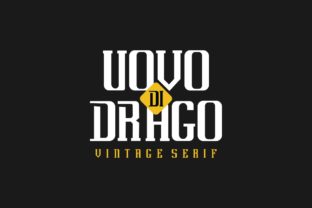
Uovo Di Drago: A Modern Serif with Quiet Confidence
Uovo Di Drago isn’t just another serif font—it’s a thoughtful balance of structure and warmth, precision and personality. Designed for clarity at any size, it carries the gravitas of traditional typography while breathing easily in digital interfaces, print layouts, and branding systems. Whether you’re drafting a newsletter, designing a book cover, or refining your small business’s visual identity, Uovo Di Drago offers restrained elegance without sacrificing readability.
What People Often Misunderstand About Uovo Di Drago
Many assume that because Uovo Di Drago feels “classic,” it must be best suited only for formal or historical contexts—like law firm letterheads or literary journals. That’s not quite right. Its generous x-height, open apertures, and carefully tuned spacing make it surprisingly versatile in UI text, blog posts, and even mobile app interfaces. The misconception arises from mistaking visual familiarity for functional limitation.
Another common oversight is treating Uovo Di Drago as a drop-in replacement for fonts like Georgia or Times New Roman—without adjusting line height, letter spacing, or weight pairing. Unlike those older workhorses, Uovo Di Drago has tighter default tracking and a more nuanced optical rhythm. Using it with unchanged CSS defaults can unintentionally compress text blocks, reducing legibility—especially on screens or in longer paragraphs.
Why Downloading or Licensing It Without Checking Details Can Backfire
Uovo Di Drago is available through several reputable foundries and marketplaces—but not all licenses are equal. Some bundles include only desktop use; others grant webfont access but restrict usage to a set number of pageviews per month. If you’re embedding it into a client’s WordPress site or an e-commerce platform, an unverified license could expose you—or them—to compliance risk or unexpected renewal fees.
Also worth noting: the font family includes multiple optical sizes (e.g., Display and Text variants), not just weights. Skipping the Text version for body copy in favor of the Display cut may seem subtle, but over time, it affects reading fatigue. The Display variant is optimized for headlines above 36pt—its finer details and tighter spacing aren’t built for sustained reading at 16–20px.
How Weight Pairing Impacts Tone—and Why It Matters
Uovo Di Drago offers a refined range of weights: Light, Regular, Medium, Semibold, Bold, and Black. But choosing “Bold” for every headline isn’t always the strongest move. Overusing heavier weights flattens hierarchy and dulls contrast. Try pairing Regular with Semibold instead of Bold—it preserves distinction while keeping emphasis subtle and professional.
For example, a freelance educator using Uovo Di Drago for course handouts might set headings in Semibold and body text in Regular at 18px/1.6 line height. That creates clear visual separation without shouting. In contrast, using Bold at the same size can feel visually heavy and distract from content—especially for learners scanning material quickly.
Real-World Checks Before You Commit
Before downloading, licensing, or integrating Uovo Di Drago into a live project, ask yourself three things:
- Where will it appear most often? If it’s primarily for web, confirm the package includes WOFF2 files and variable font support (Uovo Di Drago supports variable axes for weight and width—useful for responsive typography).
- Who will read it—and under what conditions? Test it in low-light mode, on a mid-range tablet, and with browser zoom set to 125%. Does the Regular weight still hold its shape? Does the Light weight disappear entirely? Adjusting contrast or background color may be simpler than switching fonts later.
- What’s your fallback strategy? Not all devices load custom fonts instantly. Define a sensible system font stack (e.g., Uovo Di Drago, Charter, Georgia, serif) so text remains legible and stylistically coherent during loading or if the font fails.
Avoiding the “Too Much Too Soon” Trap
Because Uovo Di Drago feels so cohesive and polished, it’s tempting to apply it everywhere—headings, buttons, captions, footers, even code snippets. But typographic harmony relies on contrast, not uniformity. Reserve Uovo Di Drago for primary text and expressive headings. For data tables, inline code, or interface labels, a clean, neutral sans-serif (like Inter or IBM Plex Sans) often serves users better by creating functional distinction.
Think of it like clothing: wearing the same well-tailored blazer with every outfit—even pajamas—undermines its impact. Let Uovo Di Drago anchor your voice, then bring in supporting typefaces to clarify roles and improve scanability.
What to Look For in a Preview—Beyond the Sample Sentence
When evaluating Uovo Di Drago on a foundry site, don’t stop at “The quick brown fox…” Scroll further. Look for:
- True italics—not slanted Romans. Uovo Di Drago’s italic has distinct letterforms (e.g., single-story a, cursive f), not algorithmic obliques. That difference matters for emphasis and authenticity.
- Numerals in both lining and old-style figures. Old-style figures (with varying heights like lowercase letters) integrate more naturally into running text. Lining figures (all same height) suit charts and headers.
- Language support beyond English. If your audience includes speakers of Romanian, Turkish, or Vietnamese, check for proper diacritic rendering—especially on ș, ğ, and tone marks. Poorly positioned accents disrupt flow and erode credibility.
Final Thought: Let It Serve Your Message, Not Just Your Aesthetic
Uovo Di Drago earns its appeal not by being flashy, but by being dependable—when used with intention. It won’t fix weak copy, compensate for poor layout, or magically boost conversions. But when matched thoughtfully to purpose, audience, and medium, it quietly elevates how your words land. Start small: use it for one project’s body text, test readability across devices, compare it side-by-side with your current font, and note where it adds calm authority versus where it feels overly deliberate. That kind of grounded experimentation—rather than chasing trends—is how enduring typographic choices are made.