Milk Nut Font
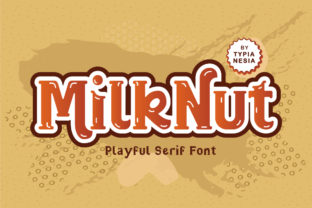
Milk Nut is a playful yet refined serif typeface designed to bring warmth, character, and subtle elegance to typographic compositions. It features gently curved serifs, open letterforms, and balanced proportions that evoke both approachability and sophistication. Unlike traditional high-contrast serifs—such as Bodoni or Didot—Milk Nut maintains moderate stroke contrast and soft terminals, making it more versatile for contemporary applications where friendliness and readability matter.
Why Designers Consider Milk Nut
Designers often seek fonts that support tone without overwhelming content. Milk Nut appeals to those working on projects where personality and clarity must coexist: brand identities for lifestyle products, editorial layouts for culture-focused publications, packaging for artisanal food or beverage lines, and digital interfaces aiming for human-centered engagement. Its name hints at its dual nature—“milk” suggesting softness and nourishment, “nut” implying compact strength and groundedness—and the design delivers on that balance.
Key Benefits of Using Milk Nut
- Distinctive voice without sacrificing legibility: Its rounded serifs and generous x-height improve readability at small sizes, especially in print or on screens with limited resolution.
- Strong visual hierarchy potential: When paired with a neutral sans-serif (e.g., Inter, Lato, or Manrope), Milk Nut excels as a display or heading font—introducing charm while letting body text remain functional.
- Consistent rhythm and spacing: The font’s even letterfit and thoughtful kerning pairs reduce manual adjustments during layout, saving time in production workflows.
- Support for diverse languages: Milk Nut includes extended Latin character sets, covering Western, Central, and Eastern European languages—useful for multilingual branding or regional publishing.
Tradeoffs and Practical Considerations
No typeface performs equally well across all contexts—and Milk Nut is no exception. Its stylistic warmth comes with constraints worth acknowledging before adoption.
First, Milk Nut is primarily intended as a display or headline font. While readable at 14–16 pt in well-lit conditions, extended body text—especially in long-form web articles or dense reports—may challenge sustained reading comfort. Its decorative qualities, though tasteful, can introduce visual noise when used at length or in low-contrast settings.
Second, Milk Nut does not currently offer a full optical size range (e.g., caption, text, subhead, display variants). Users relying on fine-tuned typographic control across scales may need to supplement with manual sizing or tracking adjustments.
Third, licensing and availability vary by vendor. Some versions are available through subscription-based platforms (e.g., Adobe Fonts), while others require one-time purchase from independent foundries. Always verify usage rights—particularly for commercial web embedding, mobile app integration, or variable font deployment.
When Milk Nut Is a Strong Fit
Milk Nut shines in scenarios where emotional resonance matters as much as function. Consider it for:
- Brand identity systems targeting audiences that value authenticity and craftsmanship—think boutique bakeries, ceramic studios, or sustainable apparel labels.
- Editorial design for magazines or newsletters focused on food, wellness, design, or slow living—where tone supports narrative rather than competes with it.
- Digital product interfaces aiming for calm, inviting UX—such as meditation apps, recipe platforms, or educational tools for younger learners.
- Print collateral like greeting cards, invitations, or limited-run posters where tactile quality and expressive typography enhance perceived value.
When Alternatives May Be More Appropriate
Milk Nut’s strengths become limitations in certain environments. If your project demands:
- High-density information delivery—such as financial dashboards, technical documentation, or academic journals—more neutral, highly legible serifs (e.g., Charter, PT Serif, or Literata) will likely serve users better.
- Strict accessibility compliance—especially WCAG AA/AAA contrast and readability thresholds—test Milk Nut rigorously. Its lighter weights and softer shapes may fall short without careful color and sizing choices.
- Monospaced or coding use cases—Milk Nut is not designed for terminal interfaces or code comments; dedicated monospaced fonts remain essential there.
- Broad cross-platform consistency—if fallback behavior is critical (e.g., email templates or legacy CMS environments), pairing Milk Nut with robust system-font stacks requires additional testing to avoid unintended rendering shifts.
Making an Informed Decision
Evaluating Milk Nut should begin with intent—not aesthetics alone. Ask yourself:
- What role does typography play in this project? Is it supporting voice and mood—or prioritizing speed, neutrality, or universal comprehension?
- At what sizes and in what mediums will it appear? Test real content—not just specimen text—at actual usage points (e.g., mobile headlines, printed business cards, desktop hero sections).
- How much typographic flexibility do you need? If you require multiple weights, italics, small caps, or variable axes, confirm Milk Nut offers them—or whether combining it with complementary fonts meets your needs.
- Who is the audience—and how might they interact with the type? A children’s book app benefits from Milk Nut’s openness and rhythm; a government health portal may require more predictable, tested alternatives.
Also consider workflow compatibility. Does your team use Figma, Adobe Creative Cloud, or open-source tools? Verify plugin or webfont integration is stable. Check file size impact if self-hosting—larger font files affect page load performance, particularly on mobile networks.
Final Thoughts
Milk Nut occupies a thoughtful niche: a serif that bridges expressive design and everyday usability. It is neither purely decorative nor strictly utilitarian—making it valuable for designers who prioritize intentionality over trend-following. Its appeal lies in restraint: enough personality to distinguish a brand, but enough structure to remain trustworthy and clear.
Ultimately, the question isn’t whether Milk Nut is “good,” but whether it serves your specific communication goals. Like any tool, its effectiveness depends less on inherent qualities and more on alignment with context, audience, and purpose. Testing early, reviewing real-world usage, and comparing against alternatives—not just visually but functionally—will lead to more confident, sustainable typographic decisions.