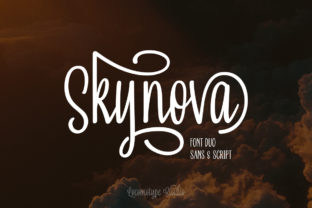
Skynova Duo: The Playful Yet Powerful Font That Elevates Every Design
Typography is far more than just “what text looks like.” It’s the silent ambassador of your message—shaping tone, guiding attention, and building emotional connection before a single word is read. Among today’s most refreshingly balanced typefaces, Skynova Duo stands out—not with loud gimmicks, but with thoughtful duality. Designed as a harmonious pair, Skynova Duo combines a delicate, airy regular weight with a confident, expressive bold weight, all rooted in the elegant Skynova family. It’s not just another font—it’s a design partner that bridges whimsy and authority, softness and strength.
What Exactly Is Skynova Duo?
Skynova Duo is a dual-weight display typeface family created to solve a common yet overlooked design challenge: how to maintain visual consistency while allowing expressive contrast between headings and body text—or between primary and secondary messaging. Unlike traditional font families that offer dozens of weights and widths, Skynova Duo intentionally focuses on two complementary cuts:
- Skynova Light: A graceful, open, and subtly rounded sans-serif with generous letter spacing and gentle curves—ideal for subtitles, captions, quotes, or minimalist branding.
- Skynova Bold: The same underlying structure, but amplified—bolder strokes, slightly tightened spacing, and refined terminals that add presence without heaviness. Perfect for headlines, logos, packaging, or hero sections.
Crucially, both weights share identical proportions, x-heights, and character widths. This means they align seamlessly in layered layouts—no awkward repositioning, no optical mismatch. When used together, they create rhythm, hierarchy, and cohesion at a glance.
Why “Playful and Delicate”—With a Bold Twist?
The phrase “playful and delicate” captures Skynova Duo’s personality—but it’s easy to misread that as “frivolous” or “too light for serious work.” In reality, its delicacy comes from intentionality: soft corners, balanced stroke contrast, and generous counters (the enclosed spaces inside letters like ‘o’ or ‘e’) that enhance legibility—even at smaller sizes. Its playfulness emerges in subtle details: a lifted terminal on the lowercase ‘a’, a friendly curve on the ‘t’, and a slight upward tilt on the crossbar of the ‘e’. These aren’t arbitrary flourishes—they’re human-centered refinements that invite engagement.
The “bold twist”? That’s where Skynova Duo surprises. Its bold weight doesn’t rely on brute thickness alone. Instead, it uses intelligent stress distribution—thicker verticals paired with carefully preserved thin horizontals—to retain elegance while commanding attention. It’s bold enough for a festival poster, yet refined enough for a luxury skincare label. That balance is rare—and deeply practical.
Where Skynova Duo Fits in Modern Design Practice
In today’s fast-scrolling, multi-device world, typography must perform across contexts—from a 4-inch smartphone screen to a 10-foot retail banner. Skynova Duo excels here because it was built for clarity *and* character:
- Digital interfaces: Its open letterforms and consistent spacing improve readability in UI elements, especially in apps focused on wellness, creativity, or education—where warmth and trust matter.
- Branding & identity: Startups and boutique studios use Skynova Duo to signal approachability without sacrificing professionalism. Think of a sustainable fashion brand using Light for product descriptions and Bold for collection names—unified, memorable, and quietly distinctive.
- Educational materials: Teachers and course designers choose it for slide decks and handouts because its high legibility reduces cognitive load—especially for neurodiverse learners or younger audiences.
- Social media & marketing: On platforms like Instagram or Pinterest, where visual impact happens in under three seconds, Skynova Duo’s bold weight grabs attention, while its light counterpart keeps captions clean and scannable.
Common Misconceptions—Clarified
Before adopting any new typeface, it helps to separate myth from reality. Here are three frequent assumptions about Skynova Duo—and why they don’t tell the full story:
- “It’s only for feminine or ‘cute’ brands.” Not true. While its curves feel inviting, Skynova Duo’s structural precision and restrained contrast give it broad neutrality. Tech newsletters, architecture studios, and even fintech dashboards use it successfully—proof that warmth and authority aren’t mutually exclusive.
- “It won’t work in long-form text.” Skynova Duo is optimized for display use—not extended body copy. But that’s by design, not limitation. Pair it with a highly legible serif or neutral sans (like Inter or Lora) for paragraphs, and you get typographic harmony: Skynova Duo sets the mood; your body font delivers the message.
- “Two weights mean limited flexibility.” Actually, fewer options often lead to stronger decisions. Designers report faster iteration times and more cohesive outputs when working within Skynova Duo’s intentional constraints. It encourages focus on hierarchy and whitespace—not weight-hopping for the sake of variety.
Real-World Examples That Bring It to Life
Consider these everyday applications—each showing how Skynova Duo solves real problems:
- A local coffee roastery uses Skynova Bold for its bag labels (“SUMMER SINGLE ORIGIN”) and Skynova Light for tasting notes (“bright citrus, honeyed apricot, silky finish”). The pairing feels artisanal, fresh, and trustworthy—no stock fonts required.
- An online learning platform applies Skynova Bold to module titles (“Master Color Theory in 5 Days”) and Light to progress indicators (“Lesson 3 of 7”). Learners subconsciously register structure and encouragement—not just information.
- A nonprofit campaign features Skynova Bold in large-scale outdoor posters (“Your Voice Moves Mountains”) with Light used for QR code instructions and website URLs. The contrast guides the eye naturally from emotion to action.
How to Use Skynova Duo Effectively (Even If You’re Not a Designer)
You don’t need advanced software or years of training to benefit from Skynova Duo. Here’s how to start smartly:
- Begin with contrast, not decoration. Use Bold for what you want people to notice first—headlines, CTAs, names. Reserve Light for supporting context: descriptions, credits, disclaimers.
- Respect scale and spacing. Skynova Duo shines when given room to breathe. Avoid cramming Light text into tight columns or shrinking Bold too small. Let its openness work for you.
- Test across devices. Preview your layout on mobile *before* finalizing. Skynova Duo’s generous counters and consistent metrics help it render crisply—even on lower-DPI screens.
- Pair thoughtfully. Complement—not compete. Try Light with a sturdy, low-contrast sans (like Inter) or Bold with a warm serif (like Lora). Avoid other decorative or high-contrast fonts nearby.
More Than a Font—A Design Mindset
At its core, Skynova Duo reflects a growing shift in how we think about visual communication: toward intention over ornamentation, harmony over hierarchy-by-default, and humanity over uniformity. It reminds us that strong design doesn’t shout—it resonates. That delicate doesn’t mean weak, and bold doesn’t require bluster. In a world saturated with visual noise, choosing Skynova Duo is a quiet act of clarity.
Whether you’re launching a personal blog, designing a client’s rebrand, or crafting classroom materials, Skynova Duo offers more than aesthetics—it offers alignment. Alignment between voice and visuals, between function and feeling, between what you say and how people feel when they read it. And in the end, that’s not just good typography. That’s meaningful communication.