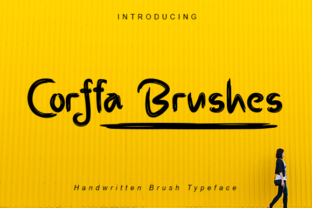
Corffa Brushes: A Handwritten Font That Delivers Charm—Without the Compromises
Corffa Brushes isn’t just another brush script font—it’s a carefully crafted handwritten typeface that balances spontaneity with clarity. Designed with natural stroke variation, subtle texture, and rhythmic spacing, it feels authentically hand-painted while remaining highly legible at medium to large sizes. Whether you’re crafting an Instagram story, designing a boutique logo, or adding warmth to a workshop slide deck, Corffa Brushes brings contemporary charm without sacrificing professionalism.
Why People Reach for Corffa Brushes (and Why Some End Up Disappointed)
Many creators choose Corffa Brushes because they want something fresh—not generic, not overly formal, and definitely not sterile. It’s especially popular among small business owners launching lifestyle brands, educators personalizing classroom materials, and freelancers building cohesive visual identities. But enthusiasm alone doesn’t guarantee great results. Too often, users apply Corffa Brushes without considering context—and that’s where things go sideways.
Mistake #1: Using It Where Legibility Suffers
Corffa Brushes shines in headlines, quotes, invitations, and short labels—but it’s not built for body text or dense paragraphs. Its expressive flourishes and variable stroke weight can blur together at small sizes or on low-resolution screens. One freelance designer used it for an entire product brochure at 10 pt, only to learn—after printing—that customers struggled to read key features. The result? A costly reprint and lost trust.
Better approach: Reserve Corffa Brushes for display use—titles, callouts, social media banners, and logos. Pair it with a clean, neutral sans-serif (like Inter, Lato, or even system fonts) for supporting text. This contrast enhances readability *and* highlights Corffa Brushes’ personality.
Mistake #2: Assuming All “Brush” Fonts Are Interchangeable
Not all brush-style fonts behave the same way. Some lack OpenType features like contextual alternates or swashes; others have inconsistent baseline alignment or uneven letterfit. Corffa Brushes includes smart ligatures and stylistic sets—but only if your design app supports them (e.g., Adobe Creative Cloud, Affinity apps, or modern web platforms using @font-face with proper feature syntax). Skipping this step means missing out on its full expressiveness.
Before downloading or purchasing, check whether the version you’re getting includes:
- True OpenType features (not just basic character sets)
- Cross-platform compatibility (macOS, Windows, web)
- Commercial licensing clarity—especially if you’re embedding it in client work or digital products
Mistake #3: Ignoring Color, Contrast, and Background Context
Because Corffa Brushes mimics ink-on-paper texture, it relies heavily on contrast. Placing it over busy photos, gradient backgrounds, or light gray text on off-white surfaces often dulls its impact—or worse, makes it vanish. A wedding planner once used it for her website hero text over a soft watercolor background, only to find mobile users couldn’t distinguish letters like “a”, “o”, and “e”.
Solution: Test Corffa Brushes in real conditions—not just on your high-end monitor. Preview it on multiple devices, at different zoom levels, and against both light and dark backgrounds. When in doubt, add subtle text shadows (just 1–2 px, soft), increase letter-spacing slightly, or adjust tracking to open up tight connections (like “fl” or “th”).
Mistake #4: Over-Animating or Over-Styling in Motion Graphics
In After Effects or Canva animations, it’s tempting to add heavy stroke effects, rapid scaling, or jittery transitions to “enhance” Corffa Brushes’ handmade feel. But the font already carries organic rhythm—adding too much movement fights its natural flow. One marketer layered three overlapping animated versions of Corffa Brushes in a promo video, unintentionally creating visual noise instead of energy.
Try this instead: Let the font breathe. Use gentle fade-ins, modest staggered reveals, or subtle opacity shifts. If you need motion, animate the container—not the text itself. Or pair Corffa Brushes with hand-drawn icons or simple line art to reinforce the aesthetic without competing.
What to Check Before You Download or License Corffa Brushes
Not every source offering Corffa Brushes is authorized—and unofficial versions may lack updates, support, or proper licensing. Here’s what matters:
- Source legitimacy: Buy directly from reputable foundries or verified marketplaces (like Creative Market, MyFonts, or the designer’s official site). Avoid free “font download” sites—they often bundle malware or serve outdated, stripped-down files.
- Licensing scope: Read the license terms. Does it cover web use? App embedding? Merchandise? Client projects? Some licenses restrict usage per domain or require extended fees for SaaS products.
- File format & tech readiness: Ensure you get WOFF2 (for web), OTF/TTF (for desktop), and optionally variable font files if your workflow supports them. Verify that the package includes documentation on accessing alternates and language support (e.g., Latin Extended-A for accented characters).
A Realistic Way to Start Using Corffa Brushes Well
You don’t need advanced typography training to use Corffa Brushes effectively. Begin with one intentional application: a social media quote graphic, a workshop header, or a brand tagline. Use it at 36–60 pt, with generous line-height (1.4–1.6) and modest letter-spacing (+10–20 units). Try pairing it with a muted, earthy palette—think warm taupe, soft terracotta, or deep indigo—rather than high-contrast neon combos that overwhelm its subtlety.
If you’re evaluating alternatives, ask yourself: Does this font support my message—or just look trendy? Corffa Brushes works best when it reflects authenticity, not decoration. It’s not about “making things pretty.” It’s about giving voice to ideas with warmth, intention, and craft.
When chosen thoughtfully and applied with awareness, Corffa Brushes becomes more than a font—it becomes part of your visual vocabulary. And that kind of consistency builds recognition, trust, and connection—long after the first impression fades.