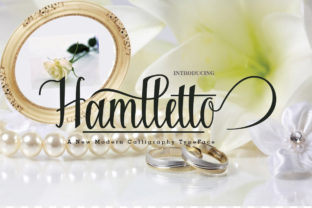
Hamlletto: An Elegant Script Font That Delivers Authenticity—Without the Pitfalls
If you’ve ever spent hours searching for a script font that feels both refined and human—not overly ornate, not too casual—chances are you’ve landed on Hamlletto. It’s a light, elegant script with subtle irregularities that mimic real handwriting: gentle variations in stroke weight, natural entry and exit strokes, and just enough personality to feel intentional, not artificial. Designers, marketers, and small business owners reach for it when they want warmth without sacrificing clarity—on wedding invites, boutique packaging, social media graphics, or even minimalist blog headers.
Why People Misjudge Hamlletto at First Glance
Many assume Hamlletto is “just another script”—and skip past it because they’ve seen similar fonts before. Others download a free version only to discover it’s missing essential OpenType features like ligatures, alternate characters, or proper kerning pairs. That mismatch between expectation and execution leads to flat, lifeless text—even though Hamlletto itself is anything but.
The issue isn’t the font. It’s how it’s approached. Hamlletto thrives in context where contrast matters: pairing it with a clean sans-serif (like Inter or Poppins) for balance, using it sparingly for emphasis—not body copy—and respecting its intended scale. When used as a headline at 36pt or larger, its elegance shines. At 12pt in a paragraph? It becomes hard to read, and the charm turns into clutter.
1. Ignoring Language Support and Character Coverage
Hamlletto includes extended Latin support—covering accented characters used across Western European languages—but doesn’t extend to Cyrillic, Greek, or Vietnamese. If your audience includes Spanish-speaking customers or bilingual French-English signage, verify that all required diacritics render correctly *before* finalizing layouts. A quick test: type “café naïve résumé” and check for missing glyphs or fallback substitutions. If you see boxes or odd spacing, you’ll need to adjust your fallback strategy—or choose a complementary font for multilingual blocks.
2. Overlooking Licensing Realities
Not all versions of Hamlletto are equal. Some marketplaces offer “free for personal use” downloads that lack stylistic sets or full punctuation. Others bundle it in font subscription services (like Adobe Fonts or Creative Market subscriptions), where usage rights differ depending on output method—e.g., web embedding may require a separate license tier. Using an unlicensed web font on a client’s e-commerce site could expose them to compliance risk. Always check the license terms directly from the foundry or authorized distributor—not just the marketplace description.
3. Skipping Kerning and Tracking Adjustments
Hamlletto was designed with optical spacing in mind, but automatic kerning in tools like Canva or older versions of Photoshop sometimes fails to activate contextual alternates or custom kerning pairs. You might notice awkward gaps after letters like “T”, “A”, or “V”. The fix isn’t switching fonts—it’s enabling OpenType features. In Illustrator or modern Figma, turn on Contextual Alternates and Kerning in the character panel. For web use, ensure your CSS includes font-feature-settings: "kern", "calt"; where supported.
What to Test Before You Commit
Before purchasing or integrating Hamlletto into a brand system, run these checks:
- Print proof at actual size: Screen rendering smooths edges; printed output reveals whether thin strokes hold up on uncoated paper or low-DPI business cards.
- Export to multiple formats: Try exporting a mockup as PDF (with fonts embedded), PNG (at 2x resolution), and SVG (for web icons). Does the flow stay consistent?
- Test accessibility contrast: Even beautiful script fonts need legibility. Use a tool like WebAIM’s Contrast Checker—especially if pairing Hamlletto with light backgrounds or pastel tones.
- Review file contents: Legitimate Hamlletto packages include .otf files (not just .ttf), a README with version notes, and often a PDF specimen showing stylistic sets. Missing documentation is a red flag.
Better Pairings, Smarter Usage
Hamlletto works best when it has room to breathe. Instead of stacking three script fonts in one layout, try this balanced approach:
- Use Hamlletto for a single focal point—like a logo wordmark or hero headline.
- Pair it with a neutral, highly legible sans-serif (e.g., Manrope or Space Grotesk) for supporting text—no decorative flourishes needed there.
- Limit color contrast: charcoal gray on off-white often reads more elegantly than stark black-on-white with Hamlletto.
- For digital use, define responsive font sizes:
font-size: clamp(1.5rem, 4vw, 2.25rem);keeps it graceful across devices without shrinking illegibly on mobile.
One real-world example: A ceramicist launching an online shop initially used Hamlletto for her entire product description block. Sales copy felt dreamy—but bounce rates spiked on mobile. Switching to Hamlletto only for the product name (“Stoneware Mug”) and using a crisp, accessible sans-serif for materials, dimensions, and care instructions improved readability *and* conversions—without losing brand voice.
A Final Note on Authenticity
“Authentic vibe” isn’t just marketing language with Hamlletto—it reflects thoughtful design decisions: ink-trail-like terminals, variable baseline sway, and rhythm that avoids robotic repetition. But authenticity doesn’t mean ignoring practical constraints. It means choosing Hamlletto *because* it fits the message—not because it looks trendy in a thumbnail.
If your goal is distinction without distraction, elegance without effort, and warmth without whimsy, Hamlletto delivers—provided you treat it with intention. Test early, license properly, pair thoughtfully, and always let the content guide the font—not the other way around.