Starled: The Handwritten Font That Brings Warmth, Personality, and Authenticity to Your Designs
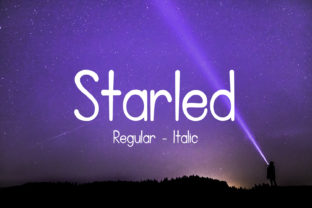
There’s a quiet power in handwriting — the slight variation in line weight, the gentle curve of a lowercase “a,” the subtle tilt that suggests human presence. In a digital landscape increasingly dominated by crisp vectors and algorithmic precision, Starled stands out not by being flashy, but by being genuinely felt. It’s not just another handwritten font. It’s a carefully crafted typeface with soft rhythm, organic flow, and unmistakable charm — designed to make your audience pause, lean in, and connect.
What Makes Starled Feel So Naturally Human?
At first glance, Starled looks effortless — like ink freshly laid down by a steady hand holding a fine-tip brush pen. But behind that ease lies thoughtful design discipline. Each glyph balances consistency with variation: letters share a cohesive slant and baseline, yet no two “s” characters are identical in stroke modulation or terminal flourish. That intentional imperfection is what signals authenticity.
The lowercase “g,” for example, features a graceful looped tail that lifts gently off the baseline — not rigid, not exaggerated, but just right. Uppercase letters carry subtle weight contrast without harsh transitions, avoiding the artificial sharpness common in over-digitized scripts. Even punctuation — like the softly rounded comma or the delicately tapered period — reinforces the tactile, handmade impression.
This isn’t calligraphy you’d find in a formal diploma; it’s the kind of writing you’d see on a hand-lettered café chalkboard, a boutique wedding invitation, or a heartfelt note tucked inside a gift box. And that’s precisely where Starled shines: in contexts where warmth matters more than formality.
Where Starled Fits Into Real-World Design Workflows
Designers don’t choose fonts in isolation — they choose them for specific jobs. With Starled, the job is almost always about humanizing something. Consider these everyday scenarios:
- Branding for small businesses: A local pottery studio, a sustainable skincare line, or an independent bookstore all benefit from typography that feels personal and grounded. Starled paired with a clean sans-serif (like Poppins or Inter) creates balance — warmth up front, clarity in supporting text.
- Digital product interfaces: While not ideal for long paragraphs or dense UI labels, Starled works beautifully in hero sections, onboarding screens, or celebratory microcopy (“You’re all set!” or “Thanks for sharing!”). Its expressive character adds emotional resonance at key moments.
- Social media visuals: Instagram quote graphics, Pinterest pins, or TikTok thumbnails gain instant appeal when Starled anchors a short, meaningful phrase. Its legibility at medium sizes (18–36px) ensures readability even on mobile — without sacrificing personality.
- Print collateral: Wedding stationery, artisanal food packaging, or indie magazine covers use Starled to signal care, craft, and intention. Because it’s well-spaced and generously kerned, it holds up beautifully in both letterpress and digital print.
Importantly, Starled was built with modern tooling in mind. It includes full OpenType support — ligatures, stylistic alternates, and contextual swashes — so designers using Figma, Adobe Illustrator, or Affinity Designer can access nuanced variations with a few clicks. No need to manually swap glyphs or rely on third-party plugins.
Practical Considerations Before You Use Starled
Like any expressive typeface, Starled thrives when used intentionally — not everywhere, but where it matters most. Here’s what smart users keep in mind:
Legibility at Smaller Sizes
Starled is optimized for display use — headlines, quotes, logos, and short statements. Below 14px, details like fine hairlines or delicate terminals begin to blur, especially on lower-resolution screens. For body copy or captions, pair it thoughtfully with a highly legible companion font. Think of Starled as the voice telling the story, and its partner as the one reading the fine print.
Weight and Contrast Balance
Starled comes in a single, thoughtfully calibrated weight — neither too light nor too bold. That makes it versatile across mediums, but also means it won’t provide dramatic visual hierarchy on its own. To create emphasis, combine size, color, spacing, or background treatment rather than switching weights. A larger Starled headline over tight, neutral body text instantly guides the eye — no bold version required.
Licensing & Technical Compatibility
Starled is available through reputable foundries and font marketplaces with clear licensing tiers — including web, desktop, app, and ePub use. Always verify the license matches your project’s scope. Most web licenses include WOFF2 files and CSS snippets, making implementation straightforward for developers. And yes — it renders cleanly across Chrome, Safari, Firefox, and Edge, with graceful fallback behavior if needed.
Why Designers Are Choosing Starled Over Generic Alternatives
Let’s be honest: there are hundreds of “handwritten” fonts online. Many are rushed, inconsistent, or overly decorative. What sets Starled apart is its integrated rhythm — the way letters connect visually, even when not joined. Words flow, not because of automatic ligatures alone, but because spacing, slant, and proportion were tested across dozens of real-word combinations: “coffee,” “together,” “forever,” “handmade.”
You’ll notice how the “f” and “l” sit comfortably side-by-side, how the “o” and “r” nestle without crowding, how ascenders and descenders breathe evenly within line height. That attention transforms Starled from a decorative element into a functional typographic tool — one that supports meaning, not just aesthetics.
It’s also refreshingly restrained. Unlike fonts that lean heavily into quirk (think exaggerated bounces or cartoonish exaggeration), Starled stays grounded. Its charm is quiet, confident, and mature — perfect for brands that want sincerity over silliness, elegance over excess.
Getting Started With Starled: Simple Tips for Stronger Results
If you’re ready to bring Starled into your next project, here are a few practical tips that go beyond basic installation:
- Start with context, not decoration: Ask, “What emotion or message do I want this word or phrase to carry?” If the answer is “trust,” “care,” or “thoughtfulness,” Starled is likely a strong fit.
- Test in real environments: Preview Starled not just in your design app, but on actual devices and in printed mockups. See how it behaves with your brand colors — does it pop against deep navy? Soften against warm beige?
- Use tracking deliberately: Slightly increased letter-spacing (50–100 units in most apps) often enhances Starled’s airy, inviting feel — especially in larger sizes. Avoid tightening unless aiming for intimacy or urgency.
- Limit to one expressive font per layout: Let Starled be the star. Pair it with a neutral, highly functional sans-serif or serif — not another script or display face. Clarity needs contrast, not competition.
And remember: typography is never just about appearance. It’s about tone, trust, and translation. When you choose Starled, you’re choosing to say, “This was made with care — by someone who values connection over convenience.” That message doesn’t get lost in translation. It lands — softly, surely, and memorably.