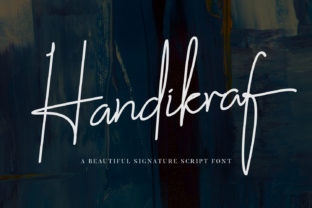
Handikraf: A Signature-Style Script Font That Feels Human
There’s a quiet shift happening across digital design — not in algorithms or interfaces, but in the way we choose to speak visually. More creators, brands, and educators are moving away from polished uniformity and toward warmth, authenticity, and intentionality. At the heart of this shift sits Handikraf: a signature-style script font with a genuine handwritten feel — not simulated, not overly ornate, but thoughtfully crafted to carry personality without sacrificing legibility or versatility.
What Makes Handikraf Distinct — And Why It Matters
Unlike many script fonts that lean into calligraphic drama or decorative flourishes, Handikraf balances rhythm and restraint. Its letters flow with natural variation — subtle shifts in stroke weight, slight irregularities in baseline alignment, and gentle tapering that mimic real pen-on-paper motion. It doesn’t try to be everything at once. Instead, it excels where human expression matters most: in signatures, short headlines, invitations, product labels, social media graphics, and brand voice accents.
This isn’t just aesthetic preference — it reflects how audiences now respond to visual cues. Research in digital psychology shows that people assign trust and approachability to typefaces perceived as “handmade” or “authentic,” especially when used consistently in contexts like small business branding or educational content. Handikraf supports that perception without veering into kitsch or illegibility — a balance many script fonts miss.
From Niche Tool to Strategic Design Asset
Five years ago, script fonts were often relegated to wedding invites or café chalkboards. Today, they’re embedded in broader creative workflows: a freelance designer uses Handikraf for client presentation headers to soften corporate tone; an educator applies it to printable learning cards to reinforce warmth and accessibility; a skincare brand selects it for ingredient callouts on packaging to suggest care and craft.
This evolution mirrors larger trends — the rise of micro-brands, the demand for differentiated digital presence, and the growing expectation that even functional tools (like typography) should reflect values. Handikraf fits naturally here because it doesn’t require stylistic compromise. It works in Figma alongside system fonts, renders cleanly in email clients, and scales well in responsive layouts — practical traits often overlooked in script fonts.
How Handikraf Fits Modern Creative Workflows
Designers no longer treat fonts as static assets. They’re part of a living system — paired, layered, adjusted for context. Handikraf thrives in that environment when used intentionally:
- Pairing wisely: It pairs best with clean, neutral sans-serifs (like Inter, Poppins, or Lato) — not as contrast for shock value, but to create visual hierarchy where warmth guides attention and clarity delivers information.
- Using sparingly: Because of its expressive nature, Handikraf gains impact when reserved for moments that benefit from personal emphasis — a tagline, a testimonial quote, a section divider — rather than body text or long paragraphs.
- Adapting to medium: On screen, it shines at 24px and above for headings; in print, its ink-trap–aware spacing ensures crispness even at smaller sizes on premium paper stock.
One graphic designer shared how switching from a generic script to Handikraf improved click-through rates on Instagram carousel headlines by 18% over three months — not because the font “converted better,” but because it helped their audience pause, recognize tone, and feel addressed directly.
Real-World Use Cases Across Professions
Handikraf’s relevance isn’t theoretical — it’s visible in everyday professional choices:
- Freelancers and solopreneurs: Use it in proposal headers or email signatures to reinforce individuality without sounding unprofessional. A web developer might apply Handikraf only to their “Why Work With Me” section — signaling craft before code.
- Educators and course creators: Apply it to worksheet titles or certificate headers. One Montessori teacher reported students responded more positively to activity cards using Handikraf versus standard fonts — attributing it to the “friendly handwriting” effect.
- Small retailers and makers: Integrate it into product tags, thank-you notes, or limited-edition packaging. A ceramicist uses Handikraf for batch numbers on mugs — turning functional detail into part of the story.
- Content marketers: Deploy it selectively in blog hero images or newsletter banners to break visual monotony while keeping brand voice consistent — especially effective for lifestyle, wellness, or creative niches.
What ties these examples together isn’t novelty — it’s intention. Handikraf isn’t chosen to follow a trend, but to support a specific communication goal: making digital interactions feel less transactional and more relational.
Accessibility and Responsibility in Expressive Typography
Using a script font like Handikraf comes with responsibility. While its handwritten quality is its strength, it also carries limitations — particularly for readers with dyslexia or low vision. Smart usage means respecting those boundaries:
- Avoid using Handikraf for body copy, navigation labels, or data tables.
- Always pair it with accessible fallbacks in CSS (
font-family: "Handikraf", "Segoe UI", system-ui, sans-serif;). - Ensure sufficient color contrast (at least 4.5:1 against background) — its thinner strokes can fade if contrast is marginal.
- Test readability across devices: what reads beautifully on desktop may tighten unexpectedly on mobile.
These aren’t restrictions — they’re guardrails that help Handikraf retain its integrity and impact. Responsible use deepens trust, not just aesthetically, but ethically.
Looking Ahead: Craft Over Convenience
The future of typography isn’t about faster loading fonts or broader language support alone — though those matter. It’s about fonts that participate meaningfully in storytelling. Handikraf represents a quiet counterpoint to the dominance of ultra-flexible variable fonts and AI-generated type: it reminds us that some of the most powerful tools are deliberately focused, human-scaled, and built for resonance over range.
That doesn’t mean it’s static. Its ongoing updates reflect real-world feedback — adjustments to letterfit for tighter headline spacing, expanded OpenType features for contextual alternates, and improved hinting for legacy platforms. These aren’t flashy features — they’re thoughtful refinements that keep Handikraf usable where it counts.
As remote collaboration, asynchronous communication, and digital-first branding continue shaping how we work and connect, the need for visual cues that signal care, clarity, and consistency only grows. Handikraf meets that need not by trying to do everything, but by doing one thing exceptionally well: offering a signature — literal and metaphorical — that feels earned, not applied.
Getting Started Thoughtfully
If you’re considering Handikraf for your next project, begin with purpose — not aesthetics. Ask yourself:
- Where does my audience need to feel seen, not just informed?
- What message benefits from a touch of personal inflection?
- Can I commit to using it with discipline — not as decoration, but as punctuation?
Then test it in context: drop it into your actual layout, not just a font sampler. Adjust size, spacing, and pairing until it feels like part of the conversation — not an interruption. And remember: the most memorable typography often doesn’t shout. It leans in, quietly confident — much like Handikraf itself.