Quick Silver: A Handwritten Font That Feels Human—Not Handed-Down
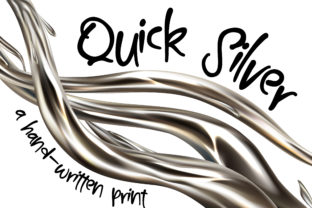
Quick Silver isn’t just another script font you’ll find in a dropdown menu. It’s a handwritten typeface with genuine texture, subtle inconsistencies, and the kind of organic rhythm that makes your designs breathe. Think of it as the difference between reading a heartfelt note on lined paper versus a perfectly aligned email auto-generated by an AI assistant—same message, wildly different feeling. That’s the core of Quick Silver: authenticity, not automation.
Where Quick Silver Fits Into Real Life (Not Just Mockups)
It’s easy to admire a beautiful font in isolation—but what really matters is where it shows up in the world, doing real work. Quick Silver shines brightest when warmth, personality, or approachability are part of the goal—not just decoration.
Craft Brands & Small-Batch Makers
If you run a ceramic studio, bake sourdough loaves by hand, or sew leather goods one at a time, Quick Silver helps your branding reflect your process—not just your product. Imagine it on a kraft paper tag tied around a bundle of dried lavender: “Hand-harvested • Small-batch • June 2024.” The slight variation in stroke weight and natural slant of Quick Silver mirrors the care behind each item. It doesn’t scream “premium”—it whispers “I made this for you.”
Wellness & Coaching Spaces
Therapists, yoga instructors, and holistic health practitioners often struggle with fonts that feel either too clinical (think sterile sans-serifs) or overly decorative (think ornate calligraphy that distracts from the message). Quick Silver lands in the sweet spot: legible enough for a workshop handout, expressive enough for an Instagram quote overlay (“Breathe first. Decide later.”), and grounded enough to avoid looking like a trend. Its gentle flow supports calm, intention, and presence—without needing to say a word about them.
Independent Publishers & Zine Creators
Zines, poetry chapbooks, and small-run art books thrive on tactile, human-made energy. Quick Silver adds that same handmade sensibility digitally—especially when used for chapter titles, pull quotes, or cover typography. One illustrator we spoke with uses it exclusively for handwritten captions beneath her ink sketches. “It doesn’t compete with my line work,” she said. “It complements it—like a second voice in the same room.”
Who Benefits—and How They Use It Differently
Quick Silver isn’t one-size-fits-all—but it *is* highly adaptable across roles, tools, and intentions.
- Freelance designers use it to add instant character to client logos for local bakeries, bookshops, or neighborhood salons—where standing out means feeling familiar, not flashy.
- Educators and course creators apply it sparingly in slide headers or worksheet titles to soften the tone of learning materials—making “Week 3: Understanding Fractions” feel less like a mandate and more like an invitation.
- Nonprofits focused on community choose Quick Silver for donor thank-you cards or event posters because it subtly signals humility and connection—not institutional distance.
- Social media managers lean into it for story text overlays or carousel quotes, especially when the voice is personal (“This changed how I parent.” or “I didn’t know I needed this until I tried it.”).
Practical Considerations Before You Type
Like any tool with character, Quick Silver works best when matched thoughtfully to its context—not just dropped in because it looks nice.
Readability Isn’t Guaranteed—It’s Earned
At smaller sizes (under 18pt), especially in body copy or dense paragraphs, Quick Silver’s connected strokes and variable spacing can slow readers down. That’s intentional—and useful—but only if it serves your purpose. Use it for headlines, short phrases, labels, or standalone quotes—not for instructions, legal disclaimers, or multi-paragraph bios. When in doubt, test it aloud: read a sentence using Quick Silver next to one in a clean sans-serif. Which one feels easier to absorb *in context*?
Pairing Matters More Than You Think
Quick Silver sings when paired with something quiet and steady—like Inter, Lora, or even a well-chosen system font (e.g., Georgia on web, SF Pro on iOS). Avoid pairing it with other high-contrast scripts or ultra-thin fonts; the result can feel fussy or ungrounded. A simple rule: if the supporting font could be the voice of a thoughtful friend, and Quick Silver is the handwriting on their postcard—it’s likely working.
Licensing Is Straightforward—but Check Your Use Case
Quick Silver is available under standard desktop, web, and app licenses. If you’re embedding it in a SaaS dashboard or generating dynamic PDFs for clients, verify your license covers that usage. Most users—including solopreneurs and small studios—find the standard license covers their needs. But if you’re building a white-label design tool or a template marketplace, double-check with the foundry.
What Quick Silver Does Well (and Where It Steps Back)
Its greatest strength is emotional resonance—not technical precision. Quick Silver excels at:
- Conveying sincerity without sentimentality
- Adding warmth to digital spaces that often feel transactional
- Creating visual hierarchy through contrast (e.g., a Quick Silver headline over neutral body text)
- Supporting brand voices that value craft, care, and continuity over novelty
It’s less ideal for:
- Brands built on speed, scale, or sharp-edged innovation (think fintech dashboards or hardware startups)
- Situations requiring multilingual support beyond basic Latin characters (it doesn’t include extended diacritics or Cyrillic)
- Accessibility-first interfaces where consistent letterform recognition is non-negotiable
- Any environment where uniformity is required—like regulatory signage or standardized testing materials
A Few Quiet Observations From Real Use
We’ve seen Quick Silver used on wedding invitations where guests commented, “It felt like the couple wrote this themselves—even though it was printed.” We’ve seen it in a pediatric clinic’s waiting room posters—softening medical language just enough to ease anxiety. And we’ve watched a food blogger switch from a trendy brush script to Quick Silver for recipe titles and notice a 22% increase in saved pins. Not because it’s “better designed,” but because it felt more trustworthy—more like someone who actually cooks, tastes, and adjusts along the way.
That’s the quiet power of Quick Silver: it doesn’t ask to be admired. It asks to be believed.