Everywhere: A Whimsical Handwritten Font That Feels Like a Hug in Type
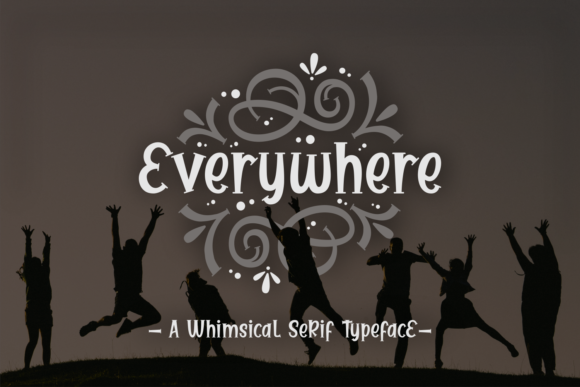
There’s a quiet magic in fonts that don’t just communicate—but connect. Everywhere isn’t just another script font; it’s a handwritten invitation to warmth, playfulness, and sincerity. With its gentle curves, uneven baseline, and affectionate irregularities, Everywhere feels like notes passed between friends—slightly smudged, full of personality, and unmistakably human.
What Makes Everywhere So Distinctly Charming?
Everywhere stands apart not because it’s technically perfect—but because it embraces imperfection with intention. Its design leans into the organic rhythm of real handwriting: letters vary subtly in size and slant, strokes taper naturally, and spacing breathes rather than rigidly aligns. This isn’t a font trying to mimic calligraphy—it’s a font that remembers how it feels to hold a pen, to pause mid-thought, to underline something important with a little extra pressure.
Key characteristics include:
- Soft, rounded terminals—no sharp edges or aggressive angles, just gentle stops that invite the eye to linger.
- Subtle ink texture suggestions—not simulated distress, but delicate variations in stroke weight that echo real ink on paper.
- Playful ligatures and alternate characters—like a friendly “&” that loops like a ribbon, or a lowercase “a” that winks with a tiny tail.
- Warm, medium-dark contrast—dark enough to read clearly, light enough to feel airy and uncluttered.
It’s this balance—between legibility and charm, structure and spontaneity—that makes Everywhere both expressive and eminently usable.
Who Finds Everyday Joy in Everywhere?
Everywhere resonates most deeply with people who value authenticity over polish—and who understand that tone matters as much as text. It’s especially beloved by:
- Creatives and illustrators—who use it for hand-drawn posters, greeting cards, and storybook covers where warmth sets the mood before a single word is read.
- Small business owners—from artisanal bakeries to indie bookshops—whose branding thrives on approachability and personal connection.
- Educators and child-focused designers—for classroom materials, learning apps, or early-reader books where friendliness supports engagement.
- Wedding and event planners—to craft invitations, signage, and digital programs that feel intimate, joyful, and lovingly handmade.
- Content creators—especially those building cozy, values-driven online spaces (think newsletters, Instagram carousels, or Notion dashboards) where voice and vibe are part of the message.
It’s less about industry and more about intention: if your goal is to soften formality, spark delight, or signal “I made this just for you,” Everywhere often fits like a favorite sweater.
Real-World Moments Where Everywhere Shines
Consider these everyday applications—each grounded in real use cases:
- A local florist’s Instagram story announcing “Sunflower Day!”—Everywhere’s looping “S” and bouncy “y” make the text feel like it was sketched beside a vase, not typed on a screen.
- A mindfulness app’s onboarding screen reading “Breathe in. Breathe out. You’re exactly where you need to be.” The font’s unhurried rhythm mirrors the instruction itself—calm, unhurried, kind.
- A children’s library newsletter titled “This Month’s Book Magic”—with Everywhere as the headline and clean sans-serif body text, the hierarchy feels intuitive and inviting, never intimidating.
- A handmade soap brand’s product label, where “Lavender & Oat Milk” appears in Everywhere beside a watercolor illustration—unifying typography and art into one cohesive, tactile experience.
In each case, Everywhere doesn’t shout. It leans in. And that subtle shift—from transactional to tender—can meaningfully shape how people receive your message.
Strengths You Can Count On (and Gentle Considerations)
Everywhere excels where emotional resonance matters most. Its strengths are clear:
- Instant warmth and familiarity—readers often describe feeling “seen” or “comforted” before even processing the words.
- Strong visual hierarchy when paired wisely—set Everywhere as a headline against a clean, neutral typeface (like Inter or Lora), and it commands attention without competing.
- High versatility across mediums—it renders beautifully on screens (with proper hinting), prints crisply at any size, and scales gracefully from social avatars to wall-sized murals.
- Low cognitive load for short bursts—ideal for titles, quotes, calls-to-action, and labels where clarity + charm work together.
That said, thoughtful use ensures best results. Everywhere isn’t designed for long-form reading—its expressive nature can fatigue the eye over paragraphs. It also performs best at medium to large sizes (18px and up on web; 24pt+ in print). And while it includes standard Latin characters and common punctuation, extended language support (e.g., accented Cyrillic or complex Arabic scripts) isn’t part of its current scope.
Think of it like a favorite spice: transformative in the right dish, overwhelming in the wrong context. Use it intentionally—not everywhere, but everywhere it matters.
How to Know If Everywhere Is Right for Your Project
Ask yourself these three questions:
- Does this piece aim to evoke feeling first? If your priority is joy, nostalgia, comfort, or whimsy—yes, Everywhere is likely a strong match.
- Is legibility needed for scanning—not sustained reading? Headlines, buttons, packaging front panels, and social thumbnails thrive with Everywhere. Novels, legal disclaimers, or dense data tables? Look elsewhere.
- Does your brand voice lean human, heartfelt, or handmade? If your tone avoids corporate stiffness—if “we’re so glad you’re here” feels more authentic than “welcome to our platform”—Everywhere will reinforce, not contradict, that voice.
If two out of three resonate strongly, test it. Try setting your key phrase in Everywhere alongside your current font. Does it feel more like *you*? Does it make the message land softer—or brighter—or kinder? Trust that instinct.
More Than a Font: A Tiny Act of Intention
In a digital landscape saturated with speed, sameness, and scrolling fatigue, choosing Everywhere is a small but meaningful choice. It says: I care how this feels—not just how it functions. It acknowledges that typography is never neutral. Every curve, every space, every decision sends a signal. Everywhere signals kindness. Patience. Play. Presence.
It won’t solve every design challenge. It won’t replace a thoughtful strategy or a well-crafted message. But in the right moment—in the headline of a heartfelt email, the title of a community workshop, the tagline on a handmade candle—it can turn ordinary communication into something quietly unforgettable.
So go ahead: download it. Sketch with it. Print it. Tuck it into your next project like a secret note. Because sometimes, the most powerful tools aren’t the flashiest—they’re the ones that make people pause, smile, and think, “Oh—I’m home.”