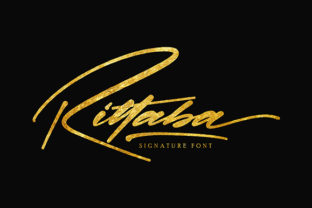
Rittaba: A Handwritten Font That Feels Like a Signature You’ve Always Wanted
There’s something quietly powerful about handwriting — the slight tilt of a letter, the gentle swell of a curve, the confident pause before a flourish. Rittaba captures that human warmth without sacrificing clarity or impact. It’s not just another script font; it’s a bold, beautiful handwritten typeface with an unmistakable charm — one that feels both intentional and effortless, like ink laid down by a practiced hand that knows exactly when to lean in and when to breathe.
When You Need Personality Without Pretense
Rittaba shines where generic fonts fall flat: in moments that call for authenticity, warmth, or quiet confidence. Think of a small-batch candle label you want to feel handmade — not mass-produced. Or the “Thank You” slide at the end of your client presentation, where a clean sans-serif feels too distant, but a fussy calligraphy font feels overdone. Rittaba bridges that gap. Its letters have rhythm and weight — generous x-height, subtle contrast, and natural entry/exit strokes — so it reads clearly even at smaller sizes, yet keeps its soul intact on large banners or social graphics.
Real People, Real Uses
Freelancers use Rittaba to sign off proposal PDFs — not as a watermark, but as part of the design, turning a routine document into something memorable. Educators embed it in printable classroom posters for vocabulary words or affirmations, because students respond more warmly to text that feels human, not robotic. Bloggers choose Rittaba for pull quotes in long-form posts — the contrast between body text (say, a readable serif) and Rittaba’s flowing lines creates visual breathing room and draws attention where it matters.
- Small business owners apply Rittaba to product tags, packaging, and Instagram story highlights — especially for brands rooted in craft, wellness, or storytelling. One ceramicist told us she switched from a free brush font to Rittaba after customers started asking, “Did you write this yourself?” That’s the effect: perceived care, not just aesthetic polish.
- Marketers use it sparingly in email headers or limited-edition campaign assets — never for body copy, but always where emotional resonance matters more than scan speed. A newsletter announcing a new workshop series? Rittaba in the subject line preview (yes, some clients render it!) adds a tactile hint of invitation.
- Hobbyists and creators layer Rittaba over photos in Canva or Photoshop for quote graphics — its open spacing prevents crowding, and its baseline consistency means it aligns cleanly with images without awkward manual nudging.
Why “Bold and Beautiful” Isn’t Just Marketing Talk
The “bold” in Rittaba isn’t about thickness alone — it’s about presence. Letters stand with quiet authority, avoiding the fragility of ultra-thin scripts or the busyness of overly decorated alternatives. The “beautiful” comes from restraint: no excessive swashes, no forced ligatures, no artificial flourishes that distract from readability. What you get instead is elegance that works — whether it’s laser-etched onto a wooden coaster or scaled down for a mobile app splash screen.
This balance makes Rittaba unusually versatile across mediums. Print designers appreciate how well it holds up in spot-color jobs (think single-ink business cards or letterpress stationery). Digital creators rely on its clean vector outlines — no pixelation, no rendering hiccups in Figma or Adobe XD. Even educators using Google Slides report fewer font substitution issues when sharing decks with colleagues, because Rittaba’s OpenType features are stable and widely supported.
What to Consider Before You Use It
Rittaba isn’t meant to replace your workhorse sans-serif or body text serif. It’s a voice — not the whole conversation. Ask yourself: Is this the *right* moment for personality? If you’re designing a safety manual or legal disclaimer, Rittaba won’t serve your audience well. But if you’re welcoming someone to your online course, introducing a new seasonal menu, or signing a heartfelt note to a client — yes, this is where it earns its place.
Also consider context. Rittaba pairs best with typefaces that give it room to breathe: neutral sans-serifs (like Inter or Poppins), warm serifs (such as Lora or Merriweather), or even monospaced fonts for deliberate contrast. Avoid pairing it with other decorative scripts — the result often feels cluttered, not curated.
Licensing matters, too. Rittaba is available in both personal and commercial licenses. If you’re using it on a client’s website, in a Shopify store banner, or on merchandise you sell, make sure you’ve selected the appropriate license tier. Some users assume “free download = free for business,” only to realize later they need to upgrade — a small step that avoids future friction.
More Than a Font — A Subtle Shift in Tone
Think about the last time you received a beautifully handwritten note. Not typed. Not stylized. Just real ink, real pressure, real intention. Rittaba doesn’t replicate that perfectly — and it shouldn’t. Instead, it distills the feeling: sincerity, care, individuality. That’s why wedding planners use it for save-the-date illustrations, why therapists add it to printable journal prompts, and why indie publishers choose it for book chapter titles — not to shout, but to invite.
It’s also surprisingly practical for accessibility-aware design. While not a WCAG-compliant font for body text, its clear letterforms (especially the distinct lowercase a, g, and l) support quick recognition in headings and short labels. When used intentionally — not as filler, but as emphasis — it supports comprehension rather than hindering it.
A Few Quiet Truths About Choosing Type
You don’t need dozens of fonts to communicate well. Often, one strong, well-chosen script like Rittaba — paired thoughtfully with two reliable companions — does more than a sprawling library ever could. It reduces decision fatigue. It builds visual continuity across your projects. And over time, it starts to feel like part of your voice — not a decoration you tack on, but a tool you reach for instinctively.
Rittaba won’t fix weak messaging or poor layout. But in the right hands, at the right moment, it can turn a good design into one that lingers — not because it’s flashy, but because it feels true.
If you’ve ever hesitated before choosing a handwritten font — worried it might look childish, dated, or hard to read — Rittaba is worth that second look. It’s timeless, not trendy. Expressive, not exaggerated. And above all, it’s built for people who create, connect, and care — not just for pixels on a screen, but for the real moments those pixels represent.