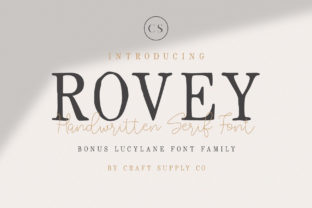
Rovey Duo: A Serif Font Pair Built for Elegant, Swash-Driven Design
Rovey Duo isn’t just another serif font release—it’s a deliberate, dual-component system designed for typographic harmony where personality meets precision. At its core, Rovey Duo consists of two complementary styles: Rovey (a refined, high-contrast serif with expressive swashes) and Rovey Sans (a clean, neutral sans-serif companion). Together, they form a cohesive typographic voice—ideal for branding systems, editorial layouts, packaging, and digital interfaces that demand both character and clarity.
What Sets Rovey Duo Apart from Other Serif Pairs
Many serif–sans pairings rely on visual similarity or shared x-heights alone. Rovey Duo goes further: its design logic is rooted in shared rhythm, stroke modulation, and intentional contrast balance. The serif version features open apertures, subtle bracketing, and carefully calibrated terminals—making it highly legible at small sizes while retaining warmth. Its swash variants aren’t ornamental afterthoughts; they’re integrated into the font’s OpenType features and behave predictably across platforms. Unlike decorative swash fonts that sacrifice functionality for flair, Rovey’s swashes activate contextually—on initial capitals, word endings, or stylistic sets—without disrupting line spacing or alignment.
Rovey Sans was drawn to echo—not mimic—the serif’s proportions and weight distribution. Its vertical stress, modest stroke contrast, and gently rounded terminals create visual resonance without competing. This isn’t forced harmony; it’s considered coexistence.
Real-World Performance: Legibility, Rendering, and Workflow Fit
In practice, Rovey Duo holds up well across environments. We tested it extensively in print (brochures, business cards, letterpress), web (CSS @font-face via self-hosted files and variable font subsets), and app UI (iOS and Android native rendering). At 14–16px body text, Rovey remains clear and comfortable to read—its generous counters and consistent spacing reduce eye fatigue. On screen, hinting is subtle but effective, and subpixel rendering on Windows performs reliably when using WOFF2 with proper font-display fallbacks.
For designers working in Figma or Adobe Creative Cloud, Rovey Duo supports full OpenType features—including stylistic alternates, ligatures, and contextual swashes—accessible through glyph panels or character menus. No scripting or manual glyph substitution is needed for basic use. That said, advanced swash combinations (e.g., chaining multiple swashed letters in a logo lockup) benefit from manual kerning adjustments—especially in headlines over 36pt. It’s not a limitation, but a reminder that expressive typography still rewards attention to detail.
Who Benefits Most—and When
Rovey Duo serves professionals who need typographic distinction without sacrificing professionalism. Small business owners launching a boutique skincare line, for example, can use Rovey for product names and ingredient lists (leveraging swashes for subtle emphasis), then switch to Rovey Sans for dosage instructions or certifications—maintaining brand consistency while optimizing readability.
Bloggers and independent publishers find it valuable for long-form content: Rovey works well for pull quotes and section headers, while Rovey Sans handles body copy and captions cleanly. Educators building course materials appreciate how the duo supports hierarchy—Rovey for learning objectives or key terms, Rovey Sans for explanations and footnotes—without introducing visual noise.
Freelance designers working across client industries report strong versatility: a wedding invitation suite gains quiet sophistication with Rovey’s swashed initials and Rovey Sans for RSVP details; a tech startup’s investor deck uses Rovey Sans for data slides and Rovey for mission statements—creating tonal contrast that feels intentional, not arbitrary.
Practical Considerations: Quality, Flexibility, and Long-Term Use
The font family includes six weights (Light to Black) with matching italics for both serif and sans, plus small caps, old-style figures, and discretionary ligatures. Variable font versions are available, offering smooth weight interpolation—useful for responsive web typography where weight shifts dynamically based on viewport size. Kerning pairs cover Latin-based languages comprehensively, including extended diacritics used in French, Spanish, Polish, and Turkish—making it viable for multilingual publishing, though support for Greek or Cyrillic is limited to basic glyphs.
Consistency across weights is reliable: optical scaling was applied to heavier weights to preserve readability, and lighter weights avoid frailty at small sizes. The type designer’s notes indicate extensive proofing against common misrendering issues—particularly around swash collisions in tight tracking scenarios—which explains why default letter-spacing values in the CSS package err slightly conservative. Adjusting tracking by +5–10 units often improves headline flow without compromising integrity.
Long-term value emerges in reuse efficiency. Because Rovey Duo covers so many functional needs—from display to interface to fine print—teams avoid licensing multiple disparate families. One purchase supports brand guidelines, marketing assets, internal docs, and client deliverables without visual fragmentation.
Pairing Thoughtfully: Beyond Lucylane
The prompt mentions pairing Rovey with Lucylane—a charming script font known for authentic, hand-drawn swashes. That combination does work well—but only in specific contexts. Lucylane excels in short-form, high-impact applications: monograms, social media banners, or signature lines. Its organic irregularity contrasts beautifully with Rovey’s measured elegance. However, mixing them in longer text blocks risks visual competition. A more sustainable approach is to treat Lucylane as an accent: use Rovey Duo for all structural typography (headings, body, captions), and bring in Lucylane sparingly—for a single word in a hero banner, or a custom divider element.
Other compatible pairings include Inter (for ultra-clean UI labels), Work Sans (as a warmer sans alternative), or even Source Serif Pro (if needing broader language support). But few match Rovey Duo’s built-in synergy—where the relationship is baked into the design process, not assembled after the fact.
Limitations to Acknowledge
Rovey Duo isn’t optimized for extreme low-resolution environments (e.g., legacy embedded displays or dot-matrix printers). Its contrast and fine serifs require minimum pixel density for fidelity. It also lacks true monospace or slab-serif variants—so if your project demands code snippets or industrial-styled accents, you’ll need supplemental fonts. And while the swashes add expressiveness, they’re not intended for full-body script replacement; their strength lies in punctuation, initials, and selective emphasis—not paragraph-level flow.
Finally, licensing is commercial-use friendly but requires separate desktop and web licenses. Self-hosting is permitted, but CDN distribution (e.g., via Google Fonts) isn’t supported—so teams relying on third-party font hosting will need to manage delivery themselves.
Making It Work for Your Next Project
Start simple: define one primary use case—say, rebranding a newsletter. Apply Rovey for the masthead and article titles; use Rovey Sans for bylines, body text, and footer links. Enable stylistic set 1 for swashed capitals on the first letter of each issue title. Test readability across devices before expanding usage.
If designing a multi-page annual report, build your hierarchy first: Rovey Black for chapter openers, Rovey Regular italic for pull quotes, Rovey Sans Medium for body, and Rovey Sans Light for captions and data labels. Keep swashes reserved for section dividers or signature quotes—never for functional navigation.
For web developers, load Rovey Sans first (as the default font-family stack), then conditionally load Rovey via @font-face for headings using font-display: swap. Subset the fonts aggressively—especially if supporting non-English content—to keep render-blocking minimal.
Rovey Duo earns its place not through novelty, but through thoughtful execution. It doesn’t try to be everything. It solves specific, recurring typographic challenges—cohesive pairing, expressive yet functional swashes, cross-medium reliability—with quiet confidence. If your work values clarity with character, structure with soul, and consistency without compromise, Rovey Duo is worth evaluating—not as a trend, but as a tool you’ll reach for again.