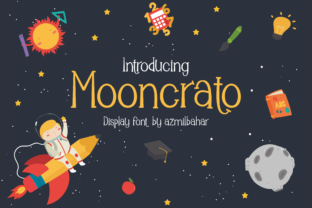
Mooncrato: A Serif Font with Whimsy, Warmth, and Purposeful Charm
Mooncrato is a serif typeface that stands apart—not by rejecting tradition, but by reimagining it with lightness and intention. Designed with rounded terminals, gentle stroke contrast, and subtly playful proportions, it carries the structural clarity of classic serifs while radiating approachability. Its joyfulness isn’t exaggerated or cartoonish; it’s quiet, sincere, and rooted in thoughtful letterform decisions—like the soft curve of its lowercase ‘a’, the open aperture of its ‘e’, or the friendly tilt of its italic forms. That balance makes Mooncrato especially useful where warmth and readability must coexist: editorial features, boutique branding, children’s book interiors, or lifestyle-focused digital experiences.
How Mooncrato Differs from Other Serifs
Most serif fonts fall into broad stylistic families—transitional (like Times New Roman), modern (such as Bodoni), or slab (like Rockwell). Mooncrato doesn’t fit neatly into any of those. It shares some structural logic with humanist serifs—its varying stroke widths and organic rhythm—but departs through intentional softness and reduced contrast. Unlike high-contrast serifs that prioritize elegance or authority, Mooncrato prioritizes emotional resonance without sacrificing legibility.
This distinction becomes clear when comparing usage contexts. A publication covering mental wellness might choose Mooncrato over a stiffer transitional serif because its openness supports calm reading at length. A small ceramics studio might select it for packaging over a geometric sans-serif to convey craftsmanship and care—not sterility. The difference isn’t just visual; it’s functional tone. Mooncrato signals thoughtfulness first, formality second.
Where Mooncrato Excels—and Where It Doesn’t
Mooncrato performs strongly in medium-to-large sizes: headlines, pull quotes, greeting cards, and short-form editorial layouts. Its generous x-height and open counters improve readability at smaller body sizes too—particularly on screens—though extended paragraphs benefit from line-height adjustments and careful measure selection. It pairs well with neutral sans-serifs (like Inter or Lato) for contrast without tension, letting Mooncrato carry voice while supporting text remains unobtrusive.
That said, Mooncrato isn’t built for every scenario. Its expressive character makes it less suited for dense legal disclaimers, technical documentation, or interfaces demanding strict neutrality—think banking dashboards or regulatory filings. Similarly, its joyful sensibility may feel mismatched in contexts requiring gravitas, austerity, or historical precision (e.g., academic journals citing 18th-century texts). These aren’t flaws—they’re natural boundaries shaped by design intent.
Real-World Fit: Three Practical Examples
- A local bookstore’s seasonal newsletter: Mooncrato sets headings and featured author blurbs, lending personality without overwhelming. Body copy uses a clean, highly legible sans-serif. Readers associate the font with curation and warmth—not corporate uniformity.
- An illustrated children’s activity book: Mooncrato appears in chapter titles and instructions. Its friendly shapes echo hand-drawn elements in the illustrations, reinforcing cohesion. It avoids the oversimplified look of many “kids’ fonts,” offering age-appropriate sophistication for ages 6–10.
- A sustainable skincare brand’s product labels: Used sparingly—for scent names and key benefits—it adds tactile charm next to minimalist typography. Here, Mooncrato functions like a subtle signature: distinctive but never distracting from ingredient transparency.
Comparing Approaches: When to Choose Mooncrato Over Alternatives
Selecting a typeface involves weighing expressive goals against practical constraints. Mooncrato often enters consideration alongside other contemporary serifs—or even carefully chosen display serifs repurposed for text. But its niche lies in bridging two needs simultaneously: aesthetic distinctiveness and functional comfort.
Consider alternatives like Playfair Display, which offers refined elegance but leans formal; or Cormorant Garamond, which evokes tradition more than playfulness. Mooncrato differs by reducing visual weight while retaining serif integrity—making it more adaptable across media. In contrast, fonts like Quicksand or Nunito offer friendliness too, but as sans-serifs they lack the typographic nuance and textural richness Mooncrato delivers in longer passages.
The decision often hinges on whether tone is a primary requirement. If your project’s success depends partly on how it *feels*—not just what it says—Mooncrato provides calibrated expressiveness. It doesn’t shout. It invites. That makes it especially valuable when audience trust, emotional connection, or perceived authenticity matter.
Technical Considerations and Implementation Realities
Mooncrato is available in multiple weights—including regular, medium, semi-bold, and italic—with consistent spacing and kerning across the family. Its OpenType features include standard ligatures, small caps, and contextual alternates, enabling nuanced typographic control without manual adjustment. For web use, variable font options may be limited depending on the source, so designers should verify file formats and loading strategies—especially if pairing with heavier web fonts elsewhere on the site.
Accessibility is handled thoughtfully: contrast ratios meet WCAG AA standards at 16px and above, and its letterforms avoid ambiguity (e.g., ‘I’, ‘l’, and ‘1’ are clearly differentiated). However, like most serifs, very small sizes (<14px) on low-DPI screens may reduce clarity—so testing across devices remains essential.
Decision Factors: Questions to Guide Your Choice
Before committing to Mooncrato—or passing it over—consider these practical questions:
- What’s the dominant emotional cue you want readers to receive? If “welcoming,” “thoughtful,” or “gentle” aligns more closely than “authoritative,” “urgent,” or “minimal,” Mooncrato fits naturally.
- How much typographic hierarchy does your layout need? Mooncrato works best when given space to breathe. If your design relies heavily on tight, multi-layered text stacks, a more compact serif or robust sans-serif may serve better.
- Who’s doing the reading—and where? Mooncrato shines in print and high-resolution displays. For long-form mobile reading, test line lengths and hyphenation behavior—its generous letter spacing can affect wrapping unpredictably without tuning.
- Is uniqueness a strategic advantage—or a risk? Mooncrato stands out quietly. If differentiation matters (e.g., standing apart in a saturated market), its distinctiveness has value. But if consistency with industry norms is preferred (e.g., finance or healthcare), familiarity may outweigh charm.
Final Perspective: Not a Universal Tool, But a Meaningful One
Mooncrato isn’t designed to replace every serif in your library. It’s designed to fill a specific, increasingly relevant gap: where humanity and clarity intersect without compromise. Its strength lies not in versatility for all situations, but in reliability within its domain—projects where typography contributes meaningfully to perception and experience.
That makes Mooncrato worth evaluating not as a default, but as an intentional choice—one made after considering audience, medium, message, and mood. When those factors align, Mooncrato doesn’t just communicate text. It extends an invitation: warm, unhurried, and quietly confident.