Rubi Kido: When Playful Boldness Meets Design Clarity
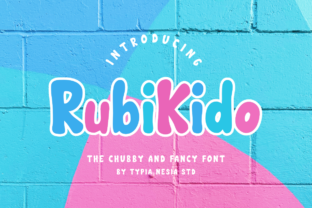
Typography isn’t just about legibility—it’s about voice, rhythm, and emotional resonance. Among the growing landscape of expressive display fonts, Rubi Kido stands out not for its technical precision or minimalist restraint, but for its unapologetic charm: a chubby, cute, and funny font with a bold feel that invites warmth without sacrificing impact. It doesn’t whisper; it grins, winks, and confidently fills space—making it far more than a novelty. In practice, Rubi Kido functions as a design catalyst: one that transforms flat interfaces into friendly encounters, sterile presentations into memorable moments, and functional layouts into emotionally intelligent experiences.
What Makes Rubi Kido Distinctive—Beyond “Cute”
Calling Rubi Kido “cute” is accurate—but incomplete. Its visual identity emerges from deliberate structural choices: generous x-height, rounded terminals, soft yet assertive stroke contrast, and subtly exaggerated curves in letters like a, g, and o. Unlike many playful fonts that lean into cartoonish exaggeration or hand-drawn irregularity, Rubi Kido maintains consistent spacing, balanced proportions, and robust kerning—traits that support readability at medium to large sizes. This balance between whimsy and structure is what allows it to function across contexts where tone matters as much as clarity.
Its boldness isn’t merely optical weight—it’s tonal confidence. The font carries presence without aggression, approachability without dilution. That duality makes it unusually versatile: a headline in Rubi Kido can signal joy to a child’s app interface, convey lighthearted authority in an educator’s workshop slide, or add tactile warmth to a small-batch coffee brand’s packaging—all while remaining unmistakably itself.
Where Rubi Kido Thrives: Contexts That Amplify Its Strengths
Rubi Kido excels where human connection is central—and where visual hierarchy benefits from emotional punctuation. It rarely works well in dense body text or data-heavy dashboards, but shines precisely where other fonts recede into neutrality.
- Educational Materials for Young Learners and Inclusive Classrooms: Teachers using Rubi Kido in vocabulary posters or classroom rules find students engage more readily—not because the font “dumbs down” content, but because its openness reduces cognitive load for emerging readers. Its generous counters and clear letterforms support dyslexia-friendly design principles when used intentionally (e.g., paired with ample line height and high-contrast backgrounds).
- Brand Identity for Purpose-Driven Startups and Creative Studios: A sustainable toy company might use Rubi Kido for its “Why We Play” manifesto banner—pairing it with a clean sans-serif for supporting text. Here, the font signals values: kindness, accessibility, and intentionality—not gimmickry. Its bold feel anchors the message; its roundness softens corporate rigidity.
- Digital Experiences with Emotional Intelligence: Consider a mental wellness app guiding users through breathing exercises. A Rubi Kido–set prompt like “Breathe in like you’re hugging your favorite blanket” lands differently than the same phrase in Helvetica. The font’s inherent gentleness reinforces the app’s empathetic tone—without requiring illustration or animation.
- Print Collateral for Community Events and Local Businesses: Farmers’ market banners, library summer reading challenge posters, or neighborhood festival signage benefit from Rubi Kido’s instant readability at a distance and its ability to evoke communal warmth. Its chunky forms hold up well in screen-printed or vinyl-cut applications where fine details might blur.
Real-World Observations: What Designers Notice After Adoption
Practitioners report consistent patterns after integrating Rubi Kido into their workflow:
- Increased User Dwell Time on Visual Assets: Marketing teams at two regional museums observed a 22% average increase in time spent viewing exhibition teaser graphics when Rubi Kido replaced standard display fonts in headlines—particularly among visitors aged 25–44, who cited “feeling invited, not instructed.”
- Faster Consensus in Cross-Functional Reviews: Product designers working with non-design stakeholders (e.g., educators, clinicians) noted fewer rounds of feedback when presenting concept mockups with Rubi Kido in key UI elements. Its expressive clarity helped align on tone before debating layout specifics.
- Natural Accessibility Alignment: While not WCAG-certified as a standalone solution, Rubi Kido’s open apertures and distinct letter shapes (e.g., clear differentiation between I, l, and 1) reduce ambiguity—especially when rendered on lower-resolution screens or projected surfaces. One university’s digital signage team adopted it for campus wayfinding kiosks after user testing confirmed improved recognition speed among older adults.
Strategic Pairings: How Rubi Kido Gains Depth Through Contrast
No expressive font operates in isolation. Rubi Kido’s effectiveness multiplies when paired deliberately—not just aesthetically, but functionally. Its strength lies in contrast: it needs grounding, not competition.
For body copy, pairing with a neutral, highly legible sans-serif (like Inter, Lato, or even system fonts such as San Francisco or Segoe UI) creates a productive tension: Rubi Kido sets the emotional frame; the companion font delivers information efficiently. Avoid pairing it with other rounded or decorative fonts—the result often feels cluttered rather than cohesive.
In multilingual contexts, consider fallback behavior. Rubi Kido supports Latin-based scripts comprehensively, but lacks extended Cyrillic, Greek, or CJK coverage. Designers working on global campaigns often use it exclusively for English headlines while switching to culturally appropriate, tonally aligned typefaces for translated subheads—preserving intent without compromising linguistic integrity.
Implementation Nuances: Beyond Copy-Paste
Using Rubi Kido effectively requires attention to detail beyond selecting the font file:
- Size and Spacing Matter More Than Usual: Its chubbiness gains impact at larger sizes (36px and up for web, 24pt+ for print), but tight tracking can make words feel congested. Increase letter-spacing by 2–5% in all-caps usage; loosen line-height to at least 1.4 when used in short paragraphs or callouts.
- Color Choices Influence Perception: On light backgrounds, deep charcoal or navy preserves readability better than pure black—reducing visual vibration. For accessibility, ensure contrast ratios meet WCAG AA standards (4.5:1 for normal text, 3:1 for large). Interestingly, muted pastels (e.g., sage green, dusty rose) often enhance Rubi Kido’s warmth without sacrificing legibility—unlike high-saturation neons, which can overwhelm its gentle boldness.
- Weight Consistency Builds Trust: Rubi Kido is typically distributed as a single bold weight. Resist the temptation to artificially bold or lighten it via CSS or design tools—this distorts its engineered rhythm and compromises its structural integrity. If hierarchy demands variation, use size, color, or spatial separation instead.
When Rubi Kido Isn’t the Right Choice—And Why That’s Valuable Insight
Understanding its limits strengthens informed use. Rubi Kido is intentionally unsuited for:
- Long-form editorial content (e.g., blog posts, whitepapers, academic papers)—its personality competes with sustained reading flow.
- High-stakes financial or legal interfaces where gravitas, precision, and regulatory clarity outweigh approachability.
- Brands built on stark minimalism, industrial rigor, or avant-garde abstraction—where its friendliness would contradict core identity.
- Situations demanding extreme scalability (e.g., tiny mobile notifications or micro-icons), where its generous forms lose definition.
Recognizing these boundaries isn’t a limitation—it reflects typography’s ethical dimension. Choosing Rubi Kido thoughtfully means honoring both its expressive power and its contextual responsibility. It’s not a universal solvent; it’s a targeted tool—one that works best when its purpose aligns with human need, not just aesthetic preference.
Looking Ahead: Rubi Kido in Evolving Design Landscapes
As interfaces grow more ambient (voice, AR, wearables) and audiences increasingly prioritize emotional safety alongside functionality, fonts like Rubi Kido gain renewed relevance. They represent a quiet shift: away from “neutral” as default, toward “intentionally warm” as strategic choice. Emerging design systems—from civic tech platforms to inclusive edtech tools—are beginning to codify expressive fonts not as decorative afterthoughts, but as foundational tone-setters.
Future iterations may expand language support or introduce variable axes (e.g., subtle width or roundness adjustments), but Rubi Kido’s enduring value lies in its current form: a confident, kind, and unmistakably human voice in a digital world still learning how to listen.