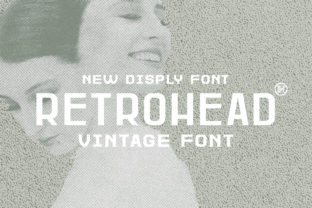
Retrohead: Timeless Clarity in Type
Imagine a font that feels both familiar and refreshingly distinct—clean enough for today’s digital interfaces, yet warm enough to evoke the quiet confidence of mid-century design. That’s Retrohead: a classic sans serif typeface rooted in simplicity, refined by intention, and built for legibility without compromise.
More Than Nostalgia—A Thoughtful Design Philosophy
Retrohead isn’t retro for retro’s sake. Its name nods to its lineage—think streamlined signage from the 1950s and 60s—but its construction is thoroughly modern. Designed with balanced proportions, open counters, and consistent stroke contrast, Retrohead achieves visual harmony across sizes and surfaces. It avoids extreme geometric rigidity (like some ultra-modern sans serifs) and steers clear of decorative flourishes (unlike many “vintage-inspired” fonts). The result? A typeface that breathes easily on screen and on paper alike.
What sets Retrohead apart isn’t just how it looks—it’s how it behaves. Its x-height is generous, improving readability at smaller sizes. Its lowercase ‘a’ and ‘g’ are single-story, reducing visual noise in body text. Uppercase letters sit with quiet authority—not shouting, but commanding attention through clarity.
Where Retrohead Finds Its Footing
Retrohead thrives where authenticity meets function. It’s equally at home in contexts demanding trust, creativity, or calm sophistication. Consider these real-world uses:
- Brand identities for studios, cafés, bookshops, or boutique services—where personality matters more than polish.
- Editorial layouts, especially long-form web articles or printed newsletters, thanks to its even rhythm and comfortable spacing.
- Product packaging for artisanal goods, wellness brands, or sustainable labels—its warmth reinforces human-centered values.
- Presentations and internal documentation for teams valuing clean communication over corporate sterility.
- Mobile interfaces and dashboard UIs where legibility under varying lighting and screen densities is non-negotiable.
It’s not a one-size-fits-all solution—and that’s part of its strength. Retrohead doesn’t try to be everything. Instead, it excels where clarity, approachability, and subtle distinction matter most.
Who Benefits Most From Retrohead?
While anyone can appreciate its elegance, Retrohead delivers exceptional value to specific users:
- Independent creators—illustrators, lettering artists, and content makers who want a reliable, expressive typeface that supports their voice without competing with it.
- Small business owners launching or refreshing a brand—especially those prioritizing authenticity over trend-chasing. With Retrohead, a strong identity emerges without needing a full design system.
- Content professionals—editors, writers, and UX writers—who craft experiences where typography quietly guides, never distracts.
- Educators and nonprofit communicators—whose materials must convey credibility and care, often with limited design resources.
- Developers building accessible websites—because Retrohead’s high legibility and robust character set (including extended Latin support and thoughtful punctuation) contribute meaningfully to inclusive design.
Strengths That Stand Up to Real Use
What makes Retrohead endure beyond first impressions?
- Scalability: Performs consistently from 12px captions to 80px headlines—no awkward thinning or blurring.
- Neutrality with nuance: It doesn’t impose mood; instead, it adapts—feeling grounded in a financial report, friendly in a community newsletter, or focused in a learning platform.
- Low cognitive load: Readers process text faster because letterforms are predictable yet distinctive—no confusing ‘I’, ‘l’, or ‘1’ moments.
- Cross-platform reliability: Renders cleanly across browsers, operating systems, and print workflows—no unexpected fallbacks or hinting hiccups.
Honest Considerations—When Retrohead Might Not Be the Best Fit
Like any well-designed tool, Retrohead shines brightest within its intended scope. Here’s when to pause and reflect:
If your project demands high contrast drama—think bold fashion campaigns or experimental art direction—Retrohead may feel too restrained. Its elegance lies in subtlety, not spectacle.
If you need extensive language support (e.g., Cyrillic, Arabic, or complex Indic scripts), verify current coverage. While Retrohead includes comprehensive Latin, Greek, and basic Vietnamese characters, its multilingual expansion is intentional—not exhaustive.
If your workflow relies heavily on variable font axes (like continuous weight or width adjustments), note that standard Retrohead releases are static. Some foundries offer variable versions—but always confirm licensing and technical compatibility before integrating into dynamic systems.
Putting Retrohead Into Practice: A Practical Checklist
Before adopting Retrohead, ask yourself these questions:
- Does my audience prioritize clarity over novelty? If yes, Retrohead builds trust quickly.
- Will this typeface appear in both short bursts (buttons, labels) and longer passages (articles, forms)? Its dual-strength design handles both gracefully.
- Do I have control over font loading and fallbacks? For web use, pair Retrohead with a sensible system stack (e.g.,
"Retrohead", -apple-system, BlinkMacSystemFont, "Segoe UI", sans-serif) to ensure graceful degradation. - Is licensing aligned with my use case? Check whether your intended use—web embedding, app bundling, merchandise, or commercial printing—falls within the license terms. Many Retrohead licenses are straightforward, but permissions vary by vendor.
- Have I tested it with real content—not just lorem ipsum? Try your actual headlines, body copy, and interface labels. See how it handles your longest line, your smallest footnote, and your most common punctuation.
A Font That Grows With You
Retrohead doesn’t shout. It listens. It doesn’t chase trends—it anticipates needs: better readability, quieter hierarchy, warmer tone. In an age of visual overload, its restraint becomes its resonance.
Whether you’re sketching a logo on napkin paper or fine-tuning a responsive design system, Retrohead offers something rare: consistency with character, simplicity with soul. It reminds us that great typography isn’t about being noticed—it’s about being understood, remembered, and returned to.
So next time you’re choosing a typeface—not as decoration, but as communication—consider what Retrohead represents: timeless clarity, thoughtfully delivered.