Fango: A Whimsical Sans Serif for Creative Projects
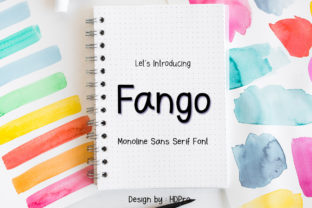
Fango is a friendly, hand-crafted sans serif font that balances playfulness with clarity. Its rounded terminals, gentle curves, and subtle irregularities give it a warm, approachable presence—like handwriting refined just enough to stay legible at any size. It’s not overly decorative, nor is it sterile or generic. That balance makes Fango especially useful when you want personality without sacrificing professionalism.
Why Designers Reach for Fango
Unlike many “cute” fonts that fade into background noise or overwhelm layouts, Fango holds attention while staying readable. Its x-height is generous, spacing is open but intentional, and letterforms avoid extreme contrast—so it works well in both short bursts (like social media banners) and longer blocks (such as workshop handouts or blog sidebars). It’s also highly legible on screens, even at smaller sizes, which matters whether you’re designing an Instagram story or a printable planner page.
What sets Fango apart isn’t just how it looks—it’s how it behaves across contexts. It pairs naturally with clean, neutral typefaces like Inter or Lato for contrast, yet stands confidently alone in minimalist designs. And because it’s designed with real-world use in mind—not just aesthetics—it includes full Latin character support, standard punctuation, numerals, and basic diacritics. No surprises mid-project.
Craft Projects That Shine With Fango
If you make physical things—stickers, greeting cards, embroidery patterns, or handmade packaging—Fango adds instant charm without looking childish or dated. Try it for:
- Handmade product labels: Pair Fango with a thin serif or monospace for ingredient lists or care instructions—Fango handles the brand name or tagline beautifully.
- Embroidery and vinyl cut files: Its smooth, connected shapes translate well to stitch paths and vector outlines. Avoid tight kerning in single-line cuts, but otherwise, it scales cleanly from 0.5" to 8".
- Print-on-demand stationery: Use Fango for quote cards, journal covers, or washi tape designs—it reads warmly in both digital previews and physical prints.
For educators and small business owners, Fango helps soften formal content. A homeschool worksheet header in Fango feels inviting—not intimidating. A local bakery’s weekly menu board gains friendliness without losing structure. The key is restraint: use it for one clear visual role per layout (e.g., headlines only), then support it with a neutral secondary font.
Digital Uses: Where Personality Meets Practicality
Fango works surprisingly well online—not just in graphics, but in live interfaces where tone matters. Bloggers use it for pull quotes and section dividers; freelancers apply it to portfolio project titles to signal creativity without shouting. On platforms like Canva or Figma, it’s easy to layer over photos or solid backgrounds thanks to its strong silhouette and consistent weight.
Marketers and small business owners find Fango effective for email headers, landing page subheadings, or limited-run promo graphics. It conveys approachability—important when building trust with new audiences—but doesn’t undermine credibility. Just avoid using it for body copy in long-form emails or web pages; its charm shines brightest in moments of emphasis.
One realistic tip: test Fango at 16–24px on mobile before finalizing. Its roundness can blur slightly below 14px on lower-DPI screens. When in doubt, increase line height by 1.4 and add 2–4px of letter-spacing for digital headings—it opens up the texture without sacrificing whimsy.
Adapting Fango Across Audiences and Goals
A children’s book illustrator might use Fango for chapter titles and speech bubbles—its soft edges echo hand-drawn illustration styles. An educator creating digital flashcards could apply it to vocabulary words, then pair it with a simple sans for definitions. A wedding stationer may set ceremony programs in Fango for names and times, switching to a delicate script only for “Mr. & Mrs.”—keeping hierarchy clear and tone cohesive.
The font’s versatility comes from its consistency, not its flexibility. It doesn’t have multiple weights or stylistic alternates, so your choices are intentional, not accidental. That limitation actually helps: it encourages thoughtful pairing and disciplined design decisions. If you need bold impact, use size, color, or placement—not weight variation.
Making Fango Feel Original (Not Trendy)
Fango stands out most when used with purpose—not just because it’s “cute.” To keep results fresh and audience-appropriate:
- Anchor it with structure: Use grids, consistent margins, and aligned baselines—even playful fonts benefit from underlying order.
- Limit color palette: One accent color + black/gray + white often lets Fango’s shape speak louder than extra hues.
- Respect context: A nonprofit’s annual report may use Fango only on the cover and donor thank-you page—not every chart label.
- Test readability early: Print a sample or view on two devices. If a headline feels “too much,” try reducing size before switching fonts.
Originality here isn’t about reinventing Fango—it’s about letting its qualities serve your message. A craft supply shop’s Instagram post featuring DIY gift tags gains warmth from Fango’s curves, but stays focused because the photo and call-to-action remain dominant. That balance is what makes the font feel intentional, not incidental.
Getting Started—No Design Degree Required
You don’t need advanced tools to use Fango well. Free graphic apps like Photopea or Google Slides handle it cleanly. For print projects, export PDFs with embedded fonts—or convert text to outlines in vector software to prevent substitution. If you’re sharing files with clients or printers, include a note: “Fango used for all headlines; no font substitution needed if embedded.”
Start small: redesign one recurring element—a newsletter subject line, a sticker template, or your Etsy shop banner. Notice how the shift affects tone and engagement. Then expand only where it adds value—not everywhere it fits.
Fango won’t solve every typographic challenge. But when you need warmth, clarity, and quiet confidence in a single typeface, it’s a reliable, human-scaled choice—one that supports your work instead of competing with it.