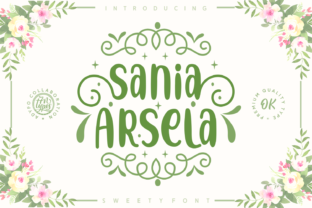
Sania Arsela: Whimsy with Weight
If you’ve ever seen a hand-lettered invitation that made you smile before you even read the words—or a boutique logo that felt like it winked at you—you’ve felt the quiet power of a well-chosen handwritten font. Sania Arsela sits right in that sweet spot: not overly fussy, not too casual, but unmistakably human. It’s a premium font built around confidence and charm—bold enough to command attention, yet soft enough to feel personal. Think of it as handwriting with intention: slightly uneven baseline, gentle ink variation, rounded terminals, and a rhythm that breathes rather than races.
A Font That Feels Like a Conversation
Sania Arsela is a script font—but not the kind that swirls endlessly or demands calligraphy skills to read. Its letters have generous spacing, open counters, and subtle contrast between thick and thin strokes. That gives it clarity without sacrificing character. Unlike many modern script fonts that lean into sharp angles or exaggerated flourishes, Sania Arsela keeps its whimsy grounded: lowercase “a” and “g” are friendly and familiar; the capital “S” has a confident curve, not a dramatic swoop. It’s a display font first and foremost—not meant for body text—but it works beautifully where personality matters most: headlines, quotes, packaging accents, social media banners, and short-form brand statements.
What makes it especially useful for adults 20–50 isn’t just how it looks—it’s how it behaves. As a commercial font, it includes full Latin character sets, numerals, punctuation, and basic multilingual support (including accented characters used across Western European languages). You won’t hit a wall mid-project because the “ñ” or “ü” is missing. And while it’s not a variable font, its single-weight design is intentional: it doesn’t need light or bold variants to make an impact. Its strength is in consistency—not flexibility.
Where Sania Arsela Earns Its Place
This isn’t a font for spreadsheets or legal disclaimers. But in the right context? It becomes a quiet differentiator. Consider these real-world fits:
- Small business branding: A ceramicist launching a new line of mugs might use Sania Arsela for the product name on the bottom stamp—and pair it with a clean sans serif (like Inter or Poppins) for care instructions. The contrast feels intentional, not accidental.
- Editorial design: A food blog highlighting seasonal recipes could set recipe titles in Sania Arsela and pull quotes in a warm serif (like Lora or Merriweather). The result feels curated, not cluttered.
- Packaging design: On a small-batch honey label, Sania Arsela works beautifully for “Wildflower Honey” above a minimalist illustration—its weight holds up at 24pt on a 3-inch label, and its warmth complements natural textures.
- Social media graphics: For Instagram carousels promoting a workshop or retreat, Sania Arsela adds approachability to otherwise clean layouts—especially when layered over soft gradients or linen-textured backgrounds.
It’s less effective in dense UI interfaces, long paragraphs, or environments with low-resolution screens. But that’s not a flaw—it’s focus. Good typography knows its job, and Sania Arsela knows it’s here to introduce, invite, and distinguish—not to explain or instruct.
Pairing Without Overthinking
Font pairing isn’t about rules—it’s about resonance. With Sania Arsela, aim for contrast that supports, not competes. A geometric sans serif (like Montserrat or DM Sans) creates clean scaffolding. A warm, low-contrast serif (like Cormorant Garamond or Source Serif Pro) adds editorial depth without visual noise. Avoid other script fonts nearby—they’ll clash tonally, like two people trying to tell a story at once.
Test pairings early: set a headline in Sania Arsela at 48px, then try three different body fonts at 16px. Read them aloud. Does one feel like a natural extension of the voice? Does another make the headline seem suddenly stiff or childish? Trust that instinct. Also check line height: Sania Arsela benefits from generous leading—try 1.4–1.6x its size when used in larger displays. Tight spacing kills its airiness; too much loses its cohesion.
Licensing, Legibility, and Real-World Limits
Sania Arsela is licensed for both personal and commercial use—including logos, merchandise, web embeds (via @font-face), and digital ads—as long as you’ve purchased the appropriate license. No subscription required. No hidden fees for print runs or social impressions. That simplicity matters when you’re juggling client work, side projects, or a growing shop.
But legibility isn’t just about licensing—it’s about context. At 18px on mobile, Sania Arsela begins to lose nuance. At 14px, it’s no longer readable as intended. So reserve it for moments where size and placement give it room: hero sections, email headers, book chapter openers, or embroidered tote bag tags. If your project needs scalability across tiny app icons and large billboards, this isn’t your primary typeface—but it can be your signature accent.
Also worth noting: Sania Arsela doesn’t include stylistic alternates, swashes, or contextual ligatures. That’s a feature, not a gap. It means fewer decisions, faster implementation, and tighter brand control—especially helpful if you’re managing assets across Canva templates, Figma libraries, or WordPress themes.
When Whimsy Serves Strategy
Many designers reach for handwritten fonts hoping to signal “authenticity”—but authenticity isn’t a style choice. It’s consistency, clarity, and care. Sania Arsela supports that when used deliberately: a greeting card company using it across all seasonal launches builds recognition. A wellness coach applying it only to session titles (not testimonials or bios) reinforces tone without diluting professionalism.
You’ll know it’s working when people don’t say, “I love that font.” They say, “This feels like *them*.” That’s the mark of thoughtful typography—not novelty, but resonance. Sania Arsela doesn’t shout. It leans in. And in a world saturated with sameness, that kind of quiet confidence is rare—and valuable.