Stag Night: A Handwritten Font with Romantic Nuance
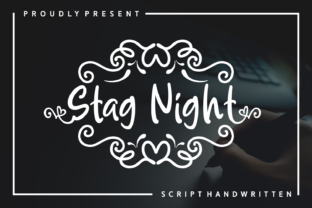
Stag Night is a carefully crafted handwritten typeface that balances elegance with approachability. It’s not a generic script—it carries a distinct romantic twist, achieved through subtle flourishes, gentle contrast in stroke weight, and an organic rhythm that mimics natural pen movement. Unlike many decorative scripts that prioritize ornamentation over function, Stag Night maintains legibility at moderate sizes while still evoking intimacy and intentionality. Its lowercase letters flow with quiet confidence; capitals offer restrained grace rather than theatrical drama. This makes it especially effective where tone matters as much as text—wedding stationery, boutique packaging, editorial features on love or legacy, or personal branding projects rooted in authenticity.
What Sets Stag Night Apart from Other Handwritten Fonts
Not all handwritten fonts serve the same purpose—or even the same audience. Some lean heavily into calligraphic formality, others embrace casual, almost messy spontaneity. Stag Night occupies a thoughtful middle ground. Its baseline is gently undulating, not rigidly horizontal, which introduces warmth without sacrificing structure. Letter spacing is open enough to avoid crowding, and the x-height is generous—both factors that support readability in real-world applications like printed invitations or small-screen web banners.
Compare this to scripts that rely on extreme thin-to-thick transitions (which can vanish at smaller sizes) or those built around exaggerated loops and ligatures (which may distract from message clarity). Stag Night avoids both extremes. It doesn’t demand attention through visual noise; instead, it earns it through consistency and restraint. That restraint is intentional—not minimalism for its own sake, but a design decision grounded in how people actually read and respond to typography in emotional contexts.
Fitness for Purpose: Where Stag Night Shines
Stag Night excels in situations where voice and vulnerability are assets—not liabilities. Consider a small-batch perfume brand launching a scent named “Evening Walk.” Using Stag Night for the product name on the label conveys quiet sophistication and tactile memory—like ink on handmade paper—without implying opulence or distance. Similarly, a couple designing their own wedding suite might choose Stag Night for names and dates because it feels personal but not childish, romantic but not clichéd.
It also works well in digital spaces where tone must be established quickly: a lifestyle blog post titled “Letters I Wrote But Never Sent” gains immediate resonance with Stag Night as a headline font. The typeface doesn’t shout; it invites. That makes it effective for brands or creators whose value lies in nuance, reflection, or emotional precision.
Limited Use Cases—and Why That’s Okay
Stag Night isn’t designed for long-form body text, multilingual publishing, or high-contrast accessibility requirements. Its character set is typically Latin-only, and while many versions include basic punctuation and numerals, extended language support or OpenType features like stylistic alternates or contextual ligatures vary by vendor. If your project requires robust diacritic coverage, dynamic scaling across responsive layouts, or strict WCAG 2.1 AA compliance for body copy, Stag Night is best reserved for display roles—headlines, quotes, logos—paired with a highly legible sans serif or low-contrast serif for supporting text.
This isn’t a shortcoming—it’s alignment with intent. Just as you wouldn’t use a chef’s paring knife to chop firewood, Stag Night isn’t meant to do everything. Its strength lies in focused application, not versatility.
Comparing Approaches: When to Choose Stag Night Over Alternatives
Choosing a handwritten font often comes down to evaluating tradeoffs between personality and practicality. One common alternative is a brush script: energetic, bold, and immediate. These work well for food brands, festivals, or youth-oriented campaigns—but they can feel too loud or informal for quieter, more reflective contexts. Stag Night offers similar warmth but with less visual velocity, making it better suited to moments that ask for pause rather than pulse.
Another option is a formal copperplate-inspired face. These communicate tradition and craftsmanship but risk feeling distant or overly ceremonial. Stag Night retains reverence for hand-drawn origin without leaning into historical rigidity. Its lowercase ‘g’ and ‘y’, for example, have soft descenders—not sharp, angular ones—softening authority into invitation.
Then there are minimalist handwritten fonts: ultra-thin, barely-there strokes meant to suggest lightness or modernity. While elegant in certain contexts, they often sacrifice expressiveness. Stag Night keeps just enough texture—subtle ink bleed simulation, slight variation in terminal endings—to feel human-made, not algorithmically smoothed.
Realistic Pairings and Practical Implementation
In practice, Stag Night performs best when paired deliberately. For print, consider combining it with a neutral serif like Merriweather or Lora for body text—fonts with similar x-heights and modest contrast that won’t compete for attention. In digital use, pairing with system fonts like Inter or Georgia provides reliable fallbacks while preserving hierarchy. Avoid pairing with other scripts or overly decorative faces; contrast should come from structure (serif vs. script), not ornamentation (script vs. script).
Also consider licensing. Stag Night is available through multiple reputable foundries, each offering different license tiers—desktop, web, app, or extended commercial use. If you’re designing for a client who will use the font across merchandise, social assets, and email templates, verify that the license covers all intended touchpoints. Some versions include alternate characters (a swash ‘Q’, a connected ‘Th’ ligature) that add polish—but only if activated via OpenType-aware software or CSS font-feature-settings. Don’t assume those variants appear automatically.
Decision Factors: Is Stag Night Right for Your Project?
Ask yourself these questions before committing:
- Does the tone of your message benefit from intimacy over authority? If yes, Stag Night’s gentle cadence supports that.
- Is legibility at 16–24pt critical—and is that size range where the font will be used most? Stag Night holds up well here, unlike many delicate scripts that blur below 20pt.
- Do you need broad language support, variable font axes, or extensive OpenType features? If so, evaluate whether the specific Stag Night release you’re considering includes them—or whether a complementary font would fill the gap.
- Will this be used in motion graphics or animated contexts? Its flowing baseline and consistent rhythm translate well to subtle animation—unlike fonts with abrupt directional shifts.
Stag Night is rarely the wrong choice for expressive, human-centered design—but it’s not always the most efficient one. If speed, scalability, or multilingual reach are primary constraints, a more utilitarian option may serve better. There’s no universal “best” font, only the best fit for a given combination of message, medium, audience, and constraint.
Final Thoughts on Intentional Typography
Typography is never neutral. Every font brings assumptions, associations, and expectations—even if quietly. Stag Night carries the quiet confidence of something written by hand, with care, for someone specific. That makes it powerful in contexts where connection matters more than scale, and resonance matters more than reach. It won’t solve brand strategy or replace strong writing—but when aligned with purpose, it deepens impact in ways that go beyond aesthetics. Whether you’re selecting fonts for a personal project or advising a team, treating Stag Night not as decoration but as a tonal instrument helps ensure it’s used with intention—not just because it looks lovely, but because it belongs.