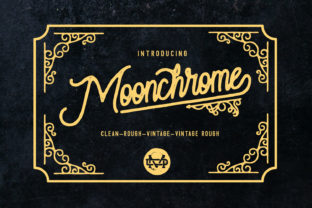
Moonchrome: Where Handwritten Charm Meets Modern Design Confidence
Design is no longer just about legibility or hierarchy—it’s about resonance. In an era where digital fatigue is real and authenticity is currency, typefaces are evolving from functional tools into emotional conduits. Enter Moonchrome: a handwritten font that balances playful charm with unmistakable boldness—designed not to whisper, but to connect with quiet confidence.
What Makes Moonchrome More Than Just “Cute”
Moonchrome is a meticulously crafted handwritten typeface—each glyph drawn with deliberate rhythm, subtle variation in stroke weight, and intentional imperfection. It avoids the overly polished sterility of digitized scripts and sidesteps the chaotic unpredictability of raw brush lettering. Instead, it occupies a rare middle ground: warm, human, and consistently expressive.
Its boldness isn’t loud—it’s grounded. The generous x-height, confident ascenders, and soft yet decisive terminals give it presence without aggression. And while its rounded forms and gentle angles evoke approachability, its tight kerning and rhythmic spacing ensure readability across sizes—from social media avatars to large-format signage.
This duality—cute yet commanding, handmade yet precise—is what sets Moonchrome apart in a saturated font market. It doesn’t ask users to choose between personality and professionalism. It delivers both, simultaneously.
Aligning With Today’s Creative and Consumer Shifts
The rise of fonts like Moonchrome reflects deeper shifts across creative practice, brand strategy, and audience expectation. Consider three converging trends:
- The Human-Centered Design Imperative: As AI-generated visuals flood feeds and interfaces, audiences increasingly gravitate toward signals of human intention—imperfections, warmth, tactile nuance. A font like Moonchrome carries the quiet authority of a hand-drawn signature: it says, “A person made this—for you.”
- The Rise of Micro-Branding: Entrepreneurs, solopreneurs, and niche creators no longer rely on corporate-scale identity systems. They need flexible, ownable assets that scale across Instagram bios, email headers, product labels, and pitch decks. Moonchrome functions as both headline anchor and tonal compass—consistent enough to build recognition, expressive enough to avoid repetition fatigue.
- Attention Economy Realities: With average scroll speeds accelerating and visual noise intensifying, typography must earn attention—not just hold it. Moonchrome achieves this through contrast: its handwritten nature stands out amid sans-serif dominance, while its structural clarity prevents cognitive drag. It’s memorable because it feels familiar—and refreshingly distinct at once.
Why Professionals Are Choosing Moonchrome—Not Just for Aesthetics
It’s easy to assume Moonchrome is chosen for mood alone. But practitioners across disciplines are adopting it for strategic, workflow-integrated reasons.
Freelancers and designers use it to quickly establish voice in client presentations—pairing Moonchrome headlines with neutral body text (like Inter or Lato) creates instant visual hierarchy *and* narrative tone. One branding consultant shared how she uses Moonchrome in early mood boards to signal “thoughtful, values-driven, human-first”—before a single logo sketch exists.
Marketers and founders deploy it where emotional resonance drives action: limited-edition product drops, newsletter subject lines, or community welcome emails. A direct-to-consumer skincare brand reported a 22% higher open rate on campaigns using Moonchrome for key CTA buttons and hero text—attributing the lift to perceived sincerity and reduced “salesy” friction.
Product teams and UX writers are exploring its utility beyond marketing. While not intended for long-form UI text, Moonchrome shines in microcopy contexts where personality matters: empty-state illustrations (“Oops—your cart’s feeling lonely 🌙”), onboarding tips, or celebratory success messages. Its boldness ensures visibility; its warmth builds trust at critical emotional touchpoints.
Practical Integration: Beyond the Obvious
Adopting Moonchrome effectively means moving past decorative application. Here’s how forward-looking professionals embed it meaningfully:
- As a Signature Element, Not a Standalone: It rarely works best in isolation. Use it for primary headlines, logo lockups, or callouts—then pair with highly legible, neutral system or web fonts for supporting content. This preserves impact while ensuring accessibility and performance.
- In Motion and Interaction: Because its letterforms have strong internal rhythm, Moonchrome animates beautifully. Subtle entrance effects—stroke drawing, staggered character reveals—amplify its handmade quality without sacrificing polish. Designers report increased engagement when using animated Moonchrome in hero sections or interactive prototypes.
- With Intentional Restraint: Its strength lies in contrast. Overuse dilutes distinction. One SaaS team found that applying Moonchrome exclusively to their “customer spotlight” section—paired with consistent photography and testimonial structure—created a recurring moment of warmth in an otherwise technical interface. Less became more, intentionally.
Technology and Accessibility: Designing Responsibly
Adopting any display font demands attention to technical execution—and Moonchrome is no exception. It ships with robust OpenType features, including stylistic alternates and ligatures, enabling nuanced expression without manual tweaking. Web font kits include WOFF2 variants optimized for fast loading, and variable-axis options (where available) allow fine-tuned weight and width control for responsive layouts.
Crucially, Moonchrome was designed with WCAG-aligned contrast ratios in mind for standard use cases. While not recommended for body text under 16px, it meets AA contrast standards at headline sizes (24px and up) against light or dark backgrounds—when paired with appropriate background colors and sufficient line spacing. Responsible implementation means testing contrast, providing fallbacks, and always prioritizing user control (e.g., respecting prefers-reduced-motion).
This technical rigor reinforces a broader truth: expressive typography no longer trades off with responsibility. Moonchrome succeeds because it bridges craft and compliance—not despite them.
The Bigger Picture: Typography as Cultural Signal
Fonts don’t exist in vacuums. They absorb and reflect cultural currents. The growing appeal of Moonchrome signals something larger than aesthetic preference—it mirrors a collective recalibration of value.
We’re moving away from the “more is more” maximalism of the early 2010s and toward considered minimalism—where every element carries purpose and personality. We’re favoring brands that speak with specificity over those that shout generically. We’re designing for people who crave connection, not just conversion.
Moonchrome fits seamlessly into this landscape—not as a trend, but as a tool aligned with enduring human needs: to be seen, to feel welcomed, and to recognize intention behind the interface.
It also represents a maturing of digital typography itself. Where early web fonts prioritized compatibility and speed, today’s leading typefaces are built for expressiveness *and* endurance. They’re engineered for variable environments, inclusive usage, and emotional intelligence. Moonchrome exemplifies this evolution: it’s not just drawn well—it’s designed for how people actually live, work, and engage online today.
Final Thought: Confidence With Character
Great design doesn’t shout. It invites. It reassures. It leaves room for the viewer to step in and belong.
That’s the quiet power of Moonchrome. It brings boldness without intimidation, charm without cliché, and handwriting without fragility. For professionals building brands, products, or communities, it offers more than visual flair—it offers a consistent, human-centered tone of voice that scales across platforms, audiences, and time.
In a world of increasing automation and algorithmic curation, choosing Moonchrome is a small but meaningful act of intention: a reminder that the most compelling digital experiences still begin—and end—with the human hand.