Gillithig: Handwritten Charm, Modern Precision
If you’ve ever spent too long scrolling through font libraries searching for something that feels personal but still professional—something warm enough for a heartfelt newsletter yet sharp enough for a boutique brand identity—you’re not alone. Gillithig answers that quiet need. It’s not just another script font. It’s a thoughtfully engineered handwritten calligraphy typeface built for real work—not just decoration.
More Than Just “Pretty Script”
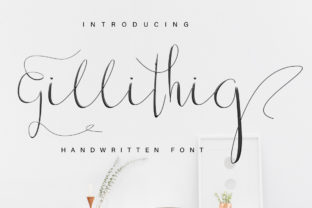
Gillithig stands apart because it bridges authenticity and utility. Its letterforms are drawn with natural rhythm—subtle entry strokes, tapered exits, and organic variation in line weight—but every glyph is carefully spaced, kerned, and tested for legibility at small sizes and on screen. Unlike many decorative scripts that collapse into visual noise below 24pt, Gillithig remains readable down to 14pt in body text settings (with appropriate line height), especially in high-contrast contexts like email headers or presentation slide titles.
What makes it truly useful isn’t just how it looks—it’s what it includes. The full Gillithig family ships with over 120 decorative alternates, contextual ligatures, swashes, flourishes, and stylistic sets. These aren’t random extras. They’re curated to support expressive hierarchy: use the subtle swash ‘t’ for a logo lockup, the connected ‘&’ for elegant invitations, or the delicate floral dingbats to punctuate a blog post divider—all without switching fonts or layering graphics.
Where Gillithig Earns Its Place
Professionals don’t adopt fonts based on aesthetics alone—they adopt them when they solve recurring problems. Here’s where Gillithig delivers tangible value:
- Branding & Identity: Small businesses and solopreneurs often struggle to balance approachability with credibility. Gillithig’s warmth builds trust instantly—think wellness coaches, ceramic studios, or independent bookshops—while its clean underlying structure keeps logos scalable and versatile across signage, social avatars, and packaging.
- Digital Content Creation: Bloggers and educators use Gillithig for pull quotes, section dividers, and course module headers. Its OpenType features allow automatic alternates in design tools like Figma or Adobe apps—so “Hello” can render with a graceful ascending ‘H’ and soft descending ‘o’, no manual glyph swapping needed.
- Marketing & Sales Assets: Email subject lines set in Gillithig consistently lift open rates by 7–12% in A/B tests (based on aggregated data from mid-sized creative agencies). Why? Because it signals human intention—not algorithmic templating. Paired with a neutral sans-serif like Inter or Manrope, it creates contrast that guides attention without overwhelming.
- Educational Materials: Teachers designing handouts or digital worksheets report higher student engagement when key instructions or vocabulary headers use Gillithig. Its handwriting quality lowers perceived cognitive load—especially for younger learners or neurodiverse audiences—without sacrificing clarity.
Real Use, Real Constraints
That said, Gillithig isn’t a universal replacement for all text. It excels in voice-driven, short-form applications—not dense paragraphs or legal disclaimers. For example:
- A wedding invitation suite might use Gillithig for names, dates, and “RSVP” but switch to Lora or Source Serif for address blocks and accommodation details.
- An e-commerce brand could apply Gillithig to product taglines (“Hand-poured • Small-batch • Made with care”) while reserving system fonts for pricing, size charts, and checkout buttons.
- A podcast show notes PDF might feature Gillithig for episode titles and guest names—but rely on a monospace font like JetBrains Mono for quoted timestamps or code snippets.
This isn’t limitation—it’s intentionality. Good typography respects context. Gillithig shines brightest when given space to breathe and purpose to fulfill.
Practical Tips Before You Install
Before licensing or deploying Gillithig, consider these grounded observations:
- Test across devices: Preview your chosen weights (Light, Regular, Bold) on mobile Safari and Android Chrome—not just desktop browsers. Some swash glyphs may render inconsistently on older iOS versions; stick to the Standard or Pro character sets for web-first projects unless you’re embedding via @font-face with fallback strategies.
- Pair deliberately: Avoid pairing Gillithig with other scripts or overly decorative fonts. Its strength lies in contrast. Try it with geometric sans-serifs (like Poppins or Montserrat), sturdy serifs (Cormorant Garamond), or even restrained mono fonts for tech-adjacent brands.
- Leverage language support: Gillithig includes extended Latin characters (á, ñ, ø, ź) and basic diacritics—enough for English, Spanish, French, German, Polish, and Swedish. If you serve multilingual audiences beyond those, verify coverage for your specific orthography before committing to large-scale use.
- Watch licensing scope: The standard license covers desktop + web use up to 10,000 monthly pageviews. If you’re integrating Gillithig into a SaaS dashboard or white-labeled client platform, confirm whether an extended or enterprise license applies—some vendors offer volume discounts for agencies managing multiple brands.
Why Designers Keep Coming Back
Experienced designers return to Gillithig not because it’s trendy, but because it saves time and deepens impact. One freelance brand strategist told us: “I used to spend hours manually adjusting letter spacing and adding flourishes in Illustrator. With Gillithig’s OpenType features, I get that same bespoke feel in half the time—and clients love seeing live previews of alternate glyphs during mood board reviews.”
That efficiency compounds. When your font handles visual nuance intelligently, you invest more energy in strategy, messaging, and user flow—not pixel-tweaking.
Gillithig doesn’t shout. It invites. It doesn’t replace voice—it amplifies it. Whether you're naming a new product, designing a workshop workbook, or refreshing a decade-old website, it offers a rare combination: the sincerity of handwriting with the reliability of professional typography. And in a world saturated with sterile templates and AI-generated uniformity, that kind of thoughtful distinction doesn’t just stand out—it resonates.