Blue Angel: Where Blackletter Tradition Meets Contemporary Design Courage
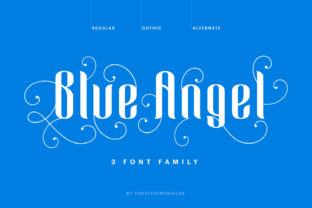
Typography is rarely neutral—it carries tone, history, and intention in every curve and serif. Among the growing landscape of expressive display fonts, Blue Angel stands apart not by sheer novelty, but by its rare balance: a delicate, yet bold blackletter font with a unique twist. It doesn’t shout for attention; it commands presence through contrast—between reverence and reinvention, intricacy and clarity, heritage and immediacy. For designers, educators, brand strategists, and even researchers exploring visual semiotics, Blue Angel offers more than aesthetic appeal—it functions as a thoughtful bridge between centuries-old typographic craft and today’s demand for distinctive, human-centered communication.
A Typeface Rooted in Craft, Refined for Clarity
Blackletter—the formal script style associated with medieval manuscripts and early European printing—has long carried weighty cultural associations: authority, solemnity, tradition. Historically, it was labor-intensive to set and difficult to read at small sizes. Modern reinterpretations often sacrifice legibility for ornamentation—or conversely, over-simplify until the soul of the form vanishes. Blue Angel avoids both pitfalls. Its letterforms retain the essential DNA of textura and rotunda—angular terminals, dense vertical stress, interlocking counters—but introduce subtle, intentional deviations: softened joins, carefully modulated stroke contrast, and open apertures in key characters like a, e, and s. These refinements aren’t decorative flourishes; they’re functional decisions that improve rhythm in setting short headlines, enhance character recognition at medium sizes (18–36pt), and allow breathing room where blackletter typically feels claustrophobic.
Consider how Blue Angel handles the lowercase g: instead of the closed, double-loop structure common in traditional blackletter, it uses a single-story form with a gently flared descender—familiar to readers of contemporary sans-serifs, yet unmistakably rooted in calligraphic gesture. That kind of quiet innovation appears across the glyph set: the r features a lifted shoulder rather than a rigid right-angle turn; the n has a slight forward lean that suggests motion without compromising stability. These are not arbitrary choices—they reflect deep study of historical models *and* empirical observation of how contemporary eyes parse shape and space.
Where Blue Angel Excels: Contexts That Demand Character and Credibility
Not every font suits every context—and that’s especially true for expressive typefaces. Blue Angel thrives where authenticity, gravitas, or narrative depth matters more than neutrality. Its strengths emerge most clearly in specific, high-impact applications:
- Cultural and academic institutions: University department headers, exhibition titles, scholarly press imprints. A history department’s “Medieval Manuscript Symposium” benefits from Blue Angel’s lineage-aware elegance—without veering into costume or caricature.
- Editorial design with voice: Long-form journalism, literary magazines, or independent publishing houses seeking distinction. When paired with a warm, highly readable serif like Adobe Garamond or STIX Two Text, Blue Angel creates compelling hierarchy—not just size-based, but tonal. The headline doesn’t just announce; it sets a mood.
- Brand identity systems requiring duality: Think craft breweries emphasizing tradition *and* experimentation, artisanal bookbinders blending old tools with modern aesthetics, or ethical fashion labels rooted in regional textile history. Blue Angel communicates legacy while feeling current—never nostalgic, never ironic.
- Educational materials focused on visual literacy: Art history slides, typography workshops, museum signage. Because its construction is both historically grounded and deliberately legible, it serves as an excellent teaching tool—students can trace the evolution from Gothic script to digital interpretation without losing sight of function.
It’s worth noting where Blue Angel does *not* belong: body copy, data dashboards, legal disclaimers, or multilingual interfaces with extensive diacritical needs (though its OpenType features include basic Latin-1 support). Its power lies in restraint—in being used where a few words must resonate deeply, not where volume or speed dominates.
Practical Integration: Pairing, Scaling, and Technical Considerations
Successful use of Blue Angel hinges less on inspiration and more on intentionality. Here’s what practitioners consistently find valuable in real-world workflows:
Strategic Pairing
Contrast is essential. Blue Angel gains definition when juxtaposed with typefaces that offer structural counterbalance. Avoid other high-contrast or ornamental fonts—competition dilutes impact. Instead, pair it with:
- Warm, organic serifs (e.g., Arno Pro, Chaparral Pro) for editorial or institutional work—creating harmony between old-world texture and modern readability.
- Neutral, humanist sans-serifs (e.g., FF Meta, HarmonyOS Sans) for branding projects needing clarity and approachability alongside tradition.
- Monospaced companions (e.g., Fira Code, IBM Plex Mono) in tech-adjacent contexts—like developer documentation or creative coding studios—where Blue Angel signals craftsmanship amid precision.
Scaling with Purpose
Blue Angel performs best between 24pt and 72pt in print, and 2.5rem to 6rem in responsive web CSS. At smaller sizes, its fine details begin to merge—especially on lower-DPI screens. On the web, always declare fallbacks (font-family: "Blue Angel", "Garamond Premier Pro", Georgia, serif;) and test rendering across browsers. Safari and Firefox handle its OpenType features (ligatures, stylistic alternates) more consistently than older Edge versions—so enable them selectively via @font-feature-settings only where supported.
Color and Contrast
Because of its inherent density, Blue Angel benefits from generous white space and thoughtful color contrast. Deep charcoal (#2E2E2E) on off-white (e.g., #F9F7F3) delivers richness without heaviness. Avoid pure black on pure white—it can feel aggressive or dated. In motion graphics or UI, subtle letter-spacing (50–100 units) prevents visual crowding and enhances scannability.
Why Designers Return to Blue Angel—Beyond Aesthetics
Over time, professionals report returning to Blue Angel not just for its appearance, but for its behavioral qualities in complex projects. Unlike many display fonts that impose a singular mood, Blue Angel adapts—its “delicate, yet bold” nature means it can feel reverent in a liturgical program, quietly confident in a nonprofit annual report, or unexpectedly playful in a boutique perfume launch (especially when set in all caps with tight tracking and a soft pastel background).
This adaptability stems from its balanced construction: vertical stress remains strong enough to convey authority, but horizontal elements—like the crossbar of the H or the baseline of the m—are drawn with gentle curvature, introducing warmth. Even its punctuation reflects this duality: periods and commas are slightly flattened, echoing calligraphic ink pooling, while colons and semicolons retain crisp geometry. These micro-decisions accumulate into macro-level trustworthiness—a quality increasingly rare in algorithm-driven design environments.
For educators, that makes Blue Angel a compelling case study in typographic ethics: how form encodes values, how legibility intersects with cultural memory, and how digital tools can extend—not erase—historical knowledge. For business owners evaluating brand assets, it represents an investment in differentiation that doesn’t rely on trend-chasing. And for hobbyists exploring lettering, it offers a masterclass in disciplined variation: every deviation from tradition serves a perceptual or semantic goal.
Looking Ahead: Blue Angel in Evolving Design Ecosystems
As generative tools reshape typography workflows—and AI-assisted font creation grows more sophisticated—Blue Angel gains renewed relevance. Its success lies not in being “AI-friendly” per se, but in embodying qualities machines still struggle to replicate meaningfully: contextual judgment, cultural fluency, and restrained innovation. Designers using Blue Angel today are often those who value intention over automation—choosing a font because it solves a problem of tone and perception, not because it’s trending on Dribbble.
Its future integration will likely expand into immersive spaces: variable font axes enabling subtle weight shifts for interactive storytelling, SVG-optimized variants for AR museum guides, or localized stylistic sets supporting bilingual cultural institutions. But its core value remains unchanged—offering a voice that is simultaneously grounded and forward-looking, intricate and accessible, reverent and resolutely present.
In an era saturated with disposable visuals, Blue Angel reminds us that typography, at its best, is neither decoration nor utility alone—it’s a vessel for meaning, shaped by hand, refined by thought, and activated by context. When chosen with care, it doesn’t just stand out. It belongs.