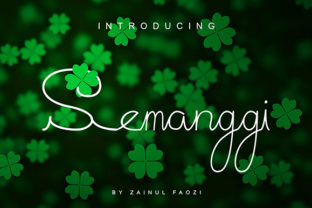
Semanggi
Semanggi is a handwritten font with quiet confidence—not flashy, not overdesigned, but unmistakably warm and intentional. Its charm lies in its subtle irregularities: slight variations in stroke weight, gentle tapering on terminals, and a rhythm that feels human rather than algorithmic. It’s not “cute” as decoration; it’s cute as character—expressive, approachable, and quietly distinctive. For professionals who choose tools deliberately—not just for aesthetics but for alignment with purpose—Semanggi offers more than visual flair. It offers tonal precision.
Why Semanggi Fits Strategic Communication, Not Just Stylistic Decoration
Most fonts serve function first: legibility, scalability, neutrality. Semanggi serves something else first—resonance. When your audience encounters a brand voice that feels personal, unhurried, and gently expressive, their attention shifts from scanning to connecting. That matters most where emotional context supports outcome: welcome emails for online courses, packaging for artisanal goods, slide decks for nonprofit storytelling, or signage in boutique retail spaces. Semanggi doesn’t shout—it invites pause. And in crowded digital environments, pause is leverage.
This isn’t about applying Semanggi everywhere. It’s about recognizing when warmth, authenticity, or gentle differentiation strengthens your message—not dilutes it. A fintech dashboard shouldn’t use Semanggi for data labels. But the onboarding email that explains how the tool simplifies financial planning? That’s where Semanggi earns its place: reinforcing trust through tone before logic even begins.
Where Semanggi Adds Real Value—And Where It Doesn’t
Strategic use starts with asking: What outcome do I need this element to support? Semanggi delivers strongest when the goal is:
- Humanizing a service—e.g., a therapist’s website using Semanggi for headings and call-to-action buttons, softening clinical associations without sacrificing professionalism;
- Differentiating a small-batch product—e.g., hand-poured candle labels where the font echoes craftsmanship, making typography part of the perceived value;
- Guiding emotional pacing in learning materials—e.g., workbook headers or reflection prompts in an educator’s downloadable resource, signaling safety and invitation rather than instruction;
- Softening brand transitions—e.g., a traditional bakery rebranding digitally: Semanggi in social bios or email signatures bridges legacy warmth with modern presence.
It weakens—or even undermines—when used without intention. Applying Semanggi to legal disclaimers, technical documentation, or multilingual interfaces introduces friction. Its personality competes with clarity. Worse, inconsistent application (e.g., mixing Semanggi headlines with ultra-sleek sans-serif body text without hierarchy or rationale) signals indecision—not creativity.
Planning Your Use: Hierarchy, Context, and Constraints
Before embedding Semanggi, map three layers:
- Functional layer: Where will it appear? Is it static (a logo lockup) or dynamic (user-generated content)? If dynamic, does your CMS or platform support fallbacks reliably?
- Hierarchical layer: What role does it play in the visual system? Semanggi works best as a primary accent—not a full-stack solution. Pair it with a neutral, highly legible sans-serif (like Inter, Lato, or Manrope) for body copy. Let Semanggi breathe in headings, quotes, or short labels only.
- Contextual layer: Who sees it, and under what conditions? On mobile? In low-light? Printed at 8pt? Test early. Its charm fades if letters blur or merge at small sizes. Reserve it for display sizes (24px and up for web, 14pt+ for print).
Also consider language support. Semanggi includes Latin characters and common diacritics—but verify coverage for your audience’s needs. If you serve bilingual audiences (e.g., English + Indonesian), confirm glyph completeness. Missing accents or unsupported punctuation break trust faster than a mismatched font ever could.
Risks of Using Semanggi Without Clear Intent
The biggest risk isn’t poor rendering—it’s misaligned perception. Semanggi carries tonal weight. Used casually, it can unintentionally signal informality where authority is needed (e.g., a compliance officer’s internal memo), or whimsy where gravitas is expected (e.g., crisis response messaging). It also risks seeming “trend-chasing” if applied without deeper brand logic—especially in sectors where consistency builds credibility over time (education, healthcare, finance).
Another practical risk: accessibility. While Semanggi passes basic contrast checks at recommended sizes, its handwritten nature reduces character distinctiveness. Letters like a, o, and e share similar rounded forms; i and l may blend in dense text. Never use it for long paragraphs, form labels, or navigation links. Screen readers don’t interpret font choice—but users relying on visual parsing do. Clarity must never be sacrificed for charm.
How to Integrate Semanggi Thoughtfully—Not Decoratively
Start narrow. Pick one high-impact, low-risk touchpoint: your email newsletter subject line, the “thank you” page after a purchase, or the title slide in your next client presentation. Define what success looks like—not “it looks nice,” but “users spend 12% longer on the page” or “conversion on the CTA increases by 5%.” Track it. Refine.
Next, build guardrails—not rules. For example:
- Usage boundary: “Semanggi appears only in non-interactive elements above 20px size.”
- Pairing constraint: “Always paired with Inter Regular for body text; never with another decorative font.”
- Context filter: “Never used in regulatory, technical, or time-sensitive communications.”
These aren’t limitations—they’re decision filters. They turn aesthetic choice into operational discipline. Over time, those filters become part of your brand’s muscle memory, reducing cognitive load during design sprints and ensuring consistency scales with growth.
Long-Term Positioning: When Semanggi Becomes Part of Your Voice
Brands that endure don’t rely on trends—they evolve tone with intention. Semanggi fits that path when treated as a voice amplifier, not a style shortcut. Think of it like a well-chosen adjective in writing: powerful in moderation, invisible when overused, and meaningless without a noun to modify.
For educators launching a new workshop series, Semanggi in the series title—paired with clean photography and structured layouts—communicates care without clutter. For a freelance designer building a portfolio site, using Semanggi only in project titles (not descriptions or contact forms) signals creative identity while preserving usability. For a small publisher releasing illustrated essay collections, Semanggi on chapter openers creates rhythm across volumes—becoming a quiet signature over time.
That kind of longevity comes not from loving the font, but from respecting its limits and leveraging its strengths with patience. It’s not about making everything “cuter.” It’s about making key moments feel more human—so the work behind them lands with greater weight.
Final Consideration: Semanggi as a Mirror for Your Priorities
Choosing a font is rarely just typographic. It’s diagnostic. If you reach for Semanggi because it feels “friendly,” ask: Is friendliness the strategic priority right now—or is clarity, speed, or authority? If you avoid it because it seems “too casual,” ask: Is that assumption based on audience research—or internal bias?
Semanggi rewards thoughtful calibration. It won’t fix unclear messaging, compensate for weak positioning, or substitute for audience insight. But when aligned with deliberate goals—human-centered communication, differentiated presence, emotionally intelligent design—it becomes more than a typeface. It becomes a quiet, consistent signal: This is who we are, and this is how we meet you.