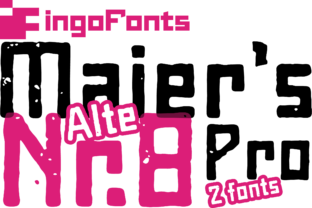
Maier s Alte Nr. 8
Maier s Alte Nr. 8 is a handwritten typeface that doesn’t just look old—it feels lived-in, thoughtful, and quietly confident. Inspired by Jugendstil (the German branch of Art Nouveau), it carries the organic flow, subtle asymmetry, and expressive stroke modulation of early 20th-century lettering. But unlike many historical revivals, Maier s Alte Nr. 8 isn’t a museum piece. It’s designed to work—today—in real projects where warmth, authenticity, and visual distinction matter more than rigid uniformity.
Where Maier s Alte Nr. 8 Finds Its Footing
You’ll rarely see Maier s Alte Nr. 8 in corporate dashboards or legal disclaimers—and that’s intentional. Its strength lies in contexts where voice, craft, and human presence are part of the message. Think of it as the typographic equivalent of a well-worn leather journal, a hand-pressed botanical print, or a locally roasted coffee bag with ink-smudged labeling: tactile, intentional, and quietly memorable.
Craft Brands & Small-Batch Producers
If you run a ceramic studio, small-batch soap line, or heritage-brewed kombucha brand, Maier s Alte Nr. 8 helps signal care without saying a word. Its slight irregularity—varied baseline, gentle swell in downstrokes, soft terminals—mirrors handmade imperfection. A label reading “Wild Rose Lavender Soap” set in Maier s Alte Nr. 8 feels like it was written by the person who mixed the oils. It pairs especially well with muted earth tones, uncoated paper stocks, and minimalist layouts that let the letterforms breathe.
Editorial & Literary Projects
Book covers for literary fiction, poetry chapbooks, or indie magazines often benefit from typography that evokes mood over utility. Maier s Alte Nr. 8 adds quiet sophistication—think of a slim volume of translated Eastern European short stories, or a memoir rooted in family letters. It’s legible at larger sizes (24–48 pt), and when used sparingly—chapter titles, drop caps, or section dividers—it creates rhythm without overwhelming the reader. Just avoid body text: its connected script and low x-height make extended reading tiring on screen or in dense paragraphs.
Wedding & Event Stationery
Couples choosing intimate, garden, or vintage-inspired weddings often gravitate toward fonts that feel personal rather than polished. Maier s Alte Nr. 8 delivers that handwritten sincerity—without looking like a generic calligraphy font from a template site. It works beautifully for names on invitations (“Elena & Theo”), ceremony programs, or even monogrammed napkin tags. Because it’s not overly ornate, it avoids feeling fussy or dated; instead, it reads as timeless, not theatrical.
Who Benefits Most—and How
Designers working with boutique clients appreciate Maier s Alte Nr. 8 for its ability to elevate simple concepts: a single-word logo for a neighborhood bakery (“Hearth”), a limited-edition poster for a jazz series, or packaging for small-run natural wine. Its character set includes standard Latin glyphs, basic punctuation, and ligatures that enhance flow—but no swashes, alternates, or multilingual support beyond Western European languages. That’s not a flaw; it’s focus.
For non-designers—say, a florist designing her own Instagram story templates or a teacher creating a handout for a creative writing workshop—Maier s Alte Nr. 8 offers immediate visual warmth. You don’t need advanced software to use it well. In Canva or Google Docs, applying it to a headline or quote block instantly shifts tone from functional to felt. Just keep it large, generous in spacing, and paired with a clean, neutral sans-serif (like Inter or Lato) for supporting text.
Practical Considerations Before You Use It
Maier s Alte Nr. 8 shines brightest when treated as an accent—not the entire ensemble. Overuse flattens its impact. Try these quick checks before committing:
- Is legibility critical? If your audience will read this on mobile, in low light, or at small sizes (under 18 pt), step back. Its delicate joins and narrow counters don’t scale down gracefully.
- Does your brand lean into craft—or clarity? Tech startups, SaaS dashboards, or healthcare materials usually prioritize speed and scannability. Maier s Alte Nr. 8 belongs where pause, reflection, or emotional resonance are part of the goal.
- Are you printing or displaying digitally? It performs best in high-resolution print (letterpress, foil stamping, embossing). On screens, use it at larger sizes and ensure sufficient contrast—especially against busy backgrounds.
- Do you need full language support? It handles English, German, French, Spanish, and Scandinavian languages well. But if your project requires Cyrillic, Greek, Vietnamese, or extended diacritics, you’ll need fallback options.
What Makes It Stand Out Among Handwritten Fonts
Many “handwritten” fonts today fall into two camps: ultra-casual (think marker-scrawled notes) or overly formal (engraved wedding scripts). Maier s Alte Nr. 8 occupies the thoughtful middle ground. Its roots in Jugendstil mean it balances structure and spontaneity—the kind of handwriting you’d find in a well-kept diary from 1908: deliberate but never stiff, elegant but never detached.
It also avoids common pitfalls: no excessive bounce, no forced quirkiness, no distracting flourishes. That restraint gives it versatility across industries—whether you’re designing a poster for a classical guitar recital or labeling jars of house-made shrubs at a farmers’ market. It doesn’t shout. It invites closer looking.
Pairing It Thoughtfully
Maier s Alte Nr. 8 thrives in contrast. Pair it with a crisp, geometric sans-serif (like Montserrat or Poppins) for modern balance—or a warm, low-contrast serif (such as Merriweather or Libre Baskerville) for layered tradition. Avoid other scripts or decorative fonts nearby; they compete rather than complement.
In layout, give it room. Generous line height (1.6–2.0), ample letter-spacing (+20–40 units in design apps), and careful alignment (left-aligned works best—centered text can feel unstable due to its natural rhythm) all help it land with intention.
A Final Note on Authenticity
Using Maier s Alte Nr. 8 isn’t about chasing nostalgia—it’s about choosing a voice that matches your values. If your work centers on slowness, materiality, attention to detail, or human-scale storytelling, this font becomes a quiet collaborator. It won’t fix weak copy or unclear messaging. But when the words are right and the intent is clear, Maier s Alte Nr. 8 helps them land with weight, warmth, and unmistakable presence.