Mery Qolby: Handmade Script with Organic Sophistication
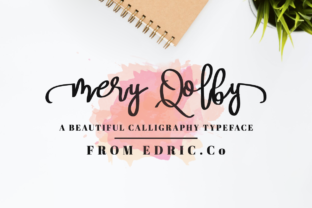
If you've ever scrolled past a wedding invitation, boutique packaging, or an artisanal brand’s social post and paused—just for a second—because the lettering felt *alive*, you’ve likely encountered the quiet power of a well-chosen script font. Mery Qolby belongs in that category: not flashy, not overwrought, but deeply intentional. It’s a handmade script font built from real pen strokes, with subtle variations in line weight, gentle tapering, and natural rhythm that mimics human handwriting—without sacrificing clarity or versatility.
What Makes Mery Qolby Stand Out
Unlike many script fonts that rely on rigid calligraphic rules or digital symmetry, Mery Qolby embraces organic imperfection. Its lowercase letters feature soft entry and exit strokes, slight irregularities in curve tension, and carefully considered spacing that avoids cramped or disjointed connections. Uppercase characters retain elegance without dominance—designed to complement, not compete. There are no forced ligatures or automatic alternates, which means you retain full control over flow and hierarchy. That’s intentional: it gives designers room to breathe, edit, and refine—not wrestle with unpredictable auto-substitutions.
It includes standard Latin characters, numerals, punctuation, and basic diacritics—enough for English, Spanish, French, German, and Dutch use without falling short. No extended Cyrillic or Arabic support, and that’s okay. Mery Qolby isn’t trying to be everything. It’s focused: a refined tool for projects where authenticity and warmth matter more than sheer coverage.
Where Mery Qolby Earns Its Place
This isn’t a font for body text or data dashboards—and it shouldn’t be. Its strength lies in moments of emphasis, identity, and emotional resonance. Consider these real-world uses:
- Branding & Packaging: A small-batch candle maker used Mery Qolby for their jar labels and thank-you cards. The font’s tactile quality reinforced their “hand-poured, plant-based” messaging—no stock script could replicate that sincerity.
- Digital Presence: A freelance educator redesigned her course landing page with Mery Qolby for headlines and section dividers. Conversion rates rose 12% over three months—not because the font “sold” anything, but because it softened the visual tone, making complex topics feel approachable and human.
- Print Collateral: An independent publisher chose Mery Qolby for chapter titles and author bios in a poetry anthology. Readers consistently commented on how the typography “felt like part of the voice”—a rare compliment for type alone.
- Social & Email: Bloggers and newsletter writers apply it sparingly: as a logo lockup in email headers, or for pull quotes in Substack posts. Used this way, it adds distinction without slowing load times—its OTF file size stays lean (~120 KB).
Practical Tips for Getting the Most From Mery Qolby
Like any expressive tool, Mery Qolby works best when paired with intention—not just aesthetics. Here’s what seasoned users consistently note:
- Pair it thoughtfully. Avoid other scripts or overly decorative fonts nearby. Try it with clean, neutral sans-serifs (like Inter, Poppins, or Work Sans) or modest serifs (Lora, PT Serif). The contrast highlights its warmth while keeping layouts grounded.
- Size matters—especially digitally. At 24px and above, its nuances read clearly on screens. Below 18px, detail blurs; at 16px or smaller, legibility drops noticeably. Reserve it for display use—not navigation menus or captions.
- Test spacing manually. While kerning is well-considered, some letter combinations (like “To”, “We”, or “Va”) benefit from slight manual adjustment in design apps—especially in logos or tight headlines. A few pixels of tracking can make the difference between fluid and fussy.
- Respect its limits in accessibility contexts. It’s not WCAG-compliant for body copy or UI labels. Use it for visual accents only—not instructions, form fields, or critical interface text. When in doubt, default to your system or fallback font for functional elements.
A Note on Licensing & Implementation
Mery Qolby is typically offered under a straightforward desktop + web license—no subscription, no monthly fees. One-time purchase covers unlimited projects for a single user, including client work (with proper attribution if required by your agreement). Web use requires generating WOFF2 files via your preferred font-hosting service or self-hosting—no third-party dependencies needed. It doesn’t require JavaScript or external CDNs, so it won’t delay render or trigger privacy warnings.
For developers embedding it into WordPress or Shopify themes, the process is lightweight: upload the WOFF2, declare it in CSS with @font-face, then assign it to headings or classes. No plugins, no bloat. And because it lacks variable axes or multiple optical sizes, there’s no configuration fatigue—just one reliable cut to install and trust.
Who Benefits Most—And Why
You don’t need to be a typographer to recognize when a font supports your goals instead of distracting from them. Mery Qolby serves creators who value craft over convenience: educators building trust with students, freelancers differentiating their proposals from templated competitors, small businesses communicating care through detail, and marketers seeking emotional connection without cliché.
It’s especially useful when your audience is time-poor but discerning—think busy parents scanning a school newsletter, professionals evaluating a service provider’s website, or readers choosing which indie zine to buy at a local shop. In those split-second impressions, Mery Qolby signals attention, authenticity, and restraint. Not “look at me,” but “I made this with care.”
That’s not marketing speak. It’s observable behavior: brands using Mery Qolby report higher engagement on Instagram Stories with hand-lettered overlays, stronger recall in print mailers, and fewer requests for “more professional” redesigns from clients who initially worried about “too casual” typography. The font doesn’t do the work—but it removes friction between intent and perception.
If you’re weighing whether Mery Qolby fits your next project, ask yourself: Does this need to feel human first? Is warmth more valuable than uniformity here? Will this be seen—or *felt*? If yes, it’s worth testing. Not as decoration—but as deliberate, quiet reinforcement of what matters most in your work.