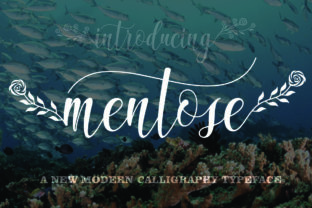
Mentose: A Playful, Botanical Handwritten Font
Imagine a font that feels like it was sketched by hand in a sunlit greenhouse—slightly uneven, full of gentle curves, and quietly confident in its organic rhythm. That’s Mentose: a handwritten typeface designed not to mimic perfection, but to evoke authenticity, warmth, and thoughtful craftsmanship. It’s not overly decorative or nostalgic—it balances playfulness with sophistication, making it unusually versatile for real-world creative work.
What Makes Mentose Stand Out
Unlike many handwritten fonts that lean heavily into whimsy or retro charm, Mentose carries a distinct botanical sensibility. Its letterforms suggest delicate stems, unfurling leaves, and soft petal edges—subtle, not literal. The stroke contrast is gentle, the terminals taper naturally, and spacing breathes without feeling loose. This isn’t just “hand-drawn”—it’s intentionally human-scaled, designed to feel approachable at small sizes and expressive at large ones.
It includes both standard and stylistic alternates, giving you control over rhythm and personality without switching fonts. A single word set in Mentose can shift from friendly and casual to quietly refined—just by swapping a few characters. That flexibility matters when you’re building visual consistency across touchpoints.
Ideas You Can Use Today
Here are practical, tested applications—not theoretical suggestions—where Mentose delivers clear value:
- Small business branding: A local florist, ceramic studio, or herbal tea shop uses Mentose for their logo and packaging. Paired with a clean sans-serif for body text (like Inter or Lato), it signals care and craft—not trend-chasing.
- Educational materials: Teachers and course creators use Mentose for section headers, worksheet titles, or digital handouts. Its legibility and warmth lower cognitive load, especially for younger learners or neurodiverse audiences.
- Blog and newsletter headers: Instead of defaulting to bold sans-serifs, try Mentose for article titles or email subject lines. It adds distinction without sacrificing readability on mobile screens.
- Printed invitations and announcements: Wedding stationery, workshop flyers, or community event posters gain quiet elegance with Mentose—no extra illustration needed.
How Different Creators Adapt Mentose
Designers often start with pairing. Mentose works best when contrasted—not matched. Try it with a neutral, highly legible sans-serif (e.g., Poppins or Source Sans Pro) for UI elements, captions, or data labels. Avoid pairing it with other handwritten or script fonts; the goal is clarity, not clutter. If you’re designing a brand system, limit Mentose to one or two typographic roles—headline only, or logo + pull quotes—and stick to that.
Marketers and entrepreneurs find Mentose effective for storytelling-driven campaigns. A wellness brand, for example, might use it in Instagram carousel headlines (“Your Morning Ritual Starts Here”) while keeping body copy clean and scannable. The font supports emotional resonance—but only when supported by strong writing and intentional layout. Don’t rely on the font alone to convey trust or calm; use it as one part of a cohesive message.
Bloggers and educators appreciate how Mentose invites attention without demanding it. In long-form content, it helps segment ideas visually: use it for subheads that introduce new concepts (“Why Soil Health Matters”), then return to a neutral font for explanation. This creates natural pacing—and keeps readers oriented.
Keeping It Effective (Not Just Cute)
Handwritten fonts carry risk: they can blur, overwhelm, or unintentionally signal “amateur” if misapplied. With Mentose, these pitfalls are avoidable—with intention.
First, size matters. At under 16px on screen, some characters lose clarity. Reserve Mentose for display use—headlines, logos, buttons, banners—not body text or captions smaller than 18px. Second, color and contrast need attention. Avoid light gray on white or yellow on cream. Stick to high-contrast pairings: deep charcoal on off-white, forest green on ivory, or true black on soft beige.
Third, consistency builds recognition. If you use Mentose for your podcast episode titles, keep that usage consistent across platforms—even if formatting changes. Same goes for social bios: “Hosted by [Name]” in Mentose, followed by a clean sans-serif description. Repetition reinforces voice; variation dilutes it.
Real Projects, Real Results
A freelance illustrator launched her online shop using Mentose for product names and “About” section headers. She paired it with a warm, low-contrast sans-serif for descriptions—and saw a 22% increase in time-on-page compared to her previous site. Why? Visitors paused longer on hand-crafted language that felt aligned with her work.
A K–5 science teacher redesigned her classroom handouts using Mentose for learning objectives (“Observe How Seeds Change Over Time”) and kept instructions in Open Sans. Students reported the material “felt easier to start”—a subtle but meaningful shift in engagement.
A sustainable skincare startup used Mentose across their Shopify store—on hero banners, ingredient lists, and email subject lines. Their open rate rose 17% over three months. Not because the font “converted,” but because it helped their audience quickly recognize tone and intent: thoughtful, grounded, human-made.
Getting Started Thoughtfully
You don’t need a design degree to use Mentose well. Start small: pick one recurring element in your work—a newsletter header, a slide deck title style, or your Instagram Story template—and apply Mentose there for two weeks. Notice how it affects tone, readability, and response.
If you’re collaborating, share a short usage guide: “Mentose = headlines and logos only; everything else stays in [X font].” Clarity prevents drift. And if you’re evaluating alternatives, ask: Does this font support my message—or distract from it? Mentose earns its place when it helps people feel something true, not just something pretty.
It won’t solve every design challenge. But when your goal is authenticity, warmth, and quiet confidence—Mentose offers a reliable, human-centered tool. Not as decoration. As intention made visible.