Don Graffiti: Bold Urban Font for Real Projects
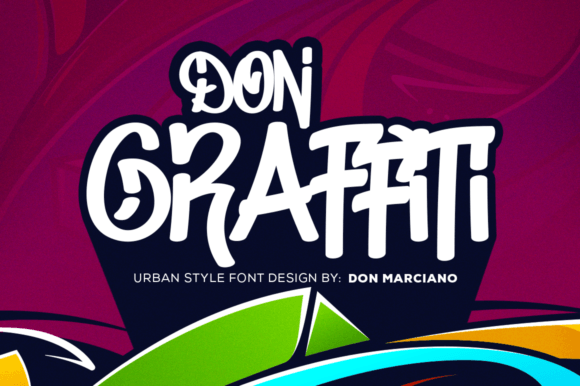
Don Graffiti isn’t just another graffiti-style font—it’s a deliberate, confident reinterpretation of street typography with intentional weight, rhythm, and readability. Designed to carry impact without sacrificing legibility, it bridges raw urban energy and professional polish. That bold twist? It’s in the thickened strokes, the subtle tapering on terminals, and the consistent baseline alignment—details that let Don Graffiti hold up in both large-scale murals and small digital interfaces.
Why Designers Reach for Don Graffiti First
When you need type that communicates attitude *and* clarity—fast—Don Graffiti delivers. Unlike many graffiti fonts that blur into illegibility at smaller sizes or feel gimmicky in formal contexts, Don Graffiti maintains structure. Its uppercase-heavy design (with thoughtful lowercase alternates) works well for branding headlines, social banners, event posters, and packaging where visual punch matters more than subtlety.
It’s especially effective when contrast is key: pairing Don Graffiti with clean sans-serifs like Inter or Roboto creates hierarchy without visual noise. Try it for a podcast logo headline over minimalist body text—or as a limited-use accent in an education nonprofit’s campaign about youth expression. The font doesn’t shout over your message; it gives it grounded emphasis.
Creative Uses Across Real-World Contexts
Don Graffiti thrives where authenticity meets intention—not chaos. Here’s how different creators apply it meaningfully:
- Small business owners use it sparingly in storefront signage or product labels for craft beer, streetwear, or local art supply shops—never for full paragraphs, but always where personality should land in under two seconds.
- Educators and workshop facilitators integrate it into slide headers for creative writing or visual arts curricula—making “Voice,” “Rhythm,” or “Rebellion” visually resonate before the lesson begins.
- Bloggers and content creators deploy it in featured image text overlays (e.g., Instagram carousels or YouTube thumbnails), especially for posts about urban culture, DIY design, or creative entrepreneurship—always testing contrast ratios to ensure accessibility.
- Freelance designers treat it as a strategic tool: one weight, one size range, one color per project. They avoid layering effects (glows, shadows, heavy outlines) unless the platform demands it—knowing Don Graffiti’s strength lies in its unembellished confidence.
What Works—and What Doesn’t
Don Graffiti shines in short-form, high-impact settings: album covers, festival lineups, skateboard deck graphics, limited-edition merch tags, or even classroom bulletin board titles. It’s less suited for long-form web copy, legal disclaimers, or data-dense infographics—where clarity trumps character.
A common misstep? Overusing it. Because it carries so much visual weight, even two words in Don Graffiti can dominate a layout. Instead of defaulting to it for every heading, try reserving it for primary calls-to-action (“Grab Your Spot,” “Drop a Line,” “Build It”) while using neutral supporting fonts elsewhere. This builds breathing room—and makes the bold moments land harder.
Adapting Don Graffiti for Different Audiences
Your audience shapes how far you push the font’s edge. A Gen Z audience engaging with a music app might respond well to Don Graffiti paired with kinetic animation and vibrant gradients. A university communications team targeting alumni donors may prefer it in deep navy or charcoal, set tightly against white space—emphasizing legacy and energy in equal measure.
For educators working with middle school students, Don Graffiti becomes a gateway: use it in vocabulary cards (“Graffiti,” “Stencil,” “Tag”) alongside photos of real-world examples—then invite students to sketch their own letterforms inspired by its structure. That turns typography into tactile learning—not decoration.
Entrepreneurs launching a creative service (like mural consulting or brand storytelling) can embed Don Graffiti into pitch decks—but only in section dividers or value proposition headers. Paired with strong photography and concise bullet points, it signals capability *and* cultural fluency without leaning on trend alone.
Practical Tips for Consistent Results
Start simple. Load Don Graffiti into your design tool and test these three settings first:
- Set tracking between –20 and –50 for tight, energetic headlines (avoid below –75—it starts to compromise readability).
- Use only the Regular or Bold weights—skip Light or ExtraBold variants unless explicitly needed for contrast in multi-weight systems.
- Always check color contrast: Don Graffiti performs best against solid, non-distracting backgrounds. Avoid busy textures or low-contrast combos like light gray on white.
If you’re exporting for web, serve Don Graffiti as a self-hosted WOFF2 file—not via third-party font services—to maintain control over loading, fallback behavior, and performance. Pair it with a system font stack (e.g., "Don Graffiti", -apple-system, BlinkMacSystemFont, "Segoe UI") so text remains readable even if the custom font fails to load.
Going Beyond the Obvious
Don Graffiti invites reinterpretation—not just replication. Some designers extract individual letters to build custom monograms or logos. Others use its stroke width as a guide for hand-drawn elements: tracing over Don Graffiti characters with a brush pen, then scanning and refining the result for a hybrid analog-digital look.
One illustrator used Don Graffiti’s “O” and “A” as base shapes for a series of illustrated city icons—turning the letterforms into stylized buildings and alleyways. Another small press embedded Don Graffiti glyphs into linocut prints, carving around the outlines to create textured, tactile book covers.
These aren’t about making Don Graffiti “more graffiti.” They’re about respecting its architecture—then building something new from it. That’s where real creative utility lives: not in applying a style, but in letting a well-designed tool spark decisions that serve your idea, your audience, and your medium.
So whether you’re designing a flyer for a neighborhood open mic, mocking up a new apparel label, or drafting slides for a talk on creative risk—try Don Graffiti where you need clarity with conviction. Not as background noise. As a considered choice. As punctuation with presence.